Saturday, 5 June 2021

INVERSE TRIGONOMETRY (COMPETITIVE)

              CHAPTER--1
               *************

1) tan(cos⁻¹x) is equal to
A) √(1-x²)/x               B) x/(1+x²)
C) √(1+x²)/x              D) √(1-x²) 

2) If sin⁻¹x= π/5, for some x ∈ (-1,1), then the value of cos⁻¹x is
A) 3π/10                     B) 5π/10 
C) 7π/10                     D) 9π/10

3) The domain of sin⁻¹x is..
A) (-π, π)                          B) [-1, 1]
C) (0, 2π)                         D)(-∞,∞)

4) The principal value of sin⁻¹(-√3/2) is...
A) -2π/3   B)-π/3  C) 4π/3  D) 5π/3

5) 4 tan⁻¹1/5 - tan⁻¹1/329 is
A) π   B) π/2      C) π/3       D) π/4

6) If sin(sin⁻¹1/5+ cos⁻¹x)= 1, then x is equal to..
A) 1        B) 0          C) 4/5     D) 1/5

7) Value of tan⁻¹1/2 + tan⁻¹1/3 is.
A) 0     B) π/3   C) π/6       D) π/4

8) If A= tan⁻¹x then sin 2A is..
A) 2x/(1-x²)              B) 2x/√(1-x²)
C) 2x/(1+x²)             D) none

9) The value of sin(2sin⁻¹(0.8)) is
A) sin 1.2°                 B) sin 1.6°
C) 0.48                      C) 0.96

10) cos⁻¹(cos(5π/4)) is given by
A) 5π/4 B) 3π/4 C) -π/4 D) none

11) cos⁻¹1/2 + 2 sin⁻¹1/2 =
A) π/4  B) π/6  C) π/3  D) 2π/3

12) If sin⁻¹x + sin⁻¹y =2π/3, then cos⁻¹x + cos⁻¹y = 
A) 2π/3   B) π/3    C) π/6   D) π 

13) tan⁻¹1/4 + tan⁻¹2/9=
A) 1/2 cos⁻¹3/5   B) 1/2 sin⁻¹3/5
C) 1/2 tan⁻¹3/5    D) tan⁻¹1/2

14) tan⁻¹x/y - tan⁻¹{(x-y)/(x+y)} =
A) π/2 B) π/3 C) π/4 D) π/4 or -3π/4

15) The solution of sin⁻¹{2a/(1-a²)} - cos⁻¹{(1-b²)/(1+b²)}= tan⁻¹{2x/(1-x²)} is...
A) (a-b)/(1-ab)        B) (1+ab)/(a-b)
C) (ab -1)/(a+b)      D) (a-b)/(1+ab)

16) If sin⁻¹x/5 + cosec⁻¹5/4=π/2, then x= 
A) 4       B) 5         C) 1          D) 3

17) 2 tan⁻¹1/3 + tan⁻¹1/7=
A) tan⁻¹49/29  B) π/2  C) 0  D) π/4

18) cos⁻¹15/17 + sin⁻¹1/5=
A) π/2 B)cos⁻¹171/221 C)π/4 D)N

19) cot [cos⁻¹(7/25)]=
A) 25/24  B) 25/7 C) 24/25   D) n

20) sin⁻¹3/5 + tan⁻¹1/7=
A) π/4  B) π/2  C)cos⁻¹4/5  D) π

21) A solution of the Equation tan⁻¹(1+x) + tan⁻¹(1-x)=π/2 is
A) x=1  B) x=-1  C) x=0   D) x=π

22) If x²+ y²+ z²= r², then tan⁻¹(xy/zr) + tan⁻¹(yz/xr) + tan⁻¹(xz/yr)=
A) π     B) π/2      C) 0       D) n

23) If x+y+z= xyz, then tan⁻¹x + tan⁻¹y + tan⁻¹z= 
A) π       B) π/2       C) 1        D) N

24) If xy+ yz+ zx= 1, then tan⁻¹x + tan⁻¹y+ tan⁻¹z =
A) π      B) π/2      C) 1       D) none

25) If x₁ , x₂ , x₃ , x₄ are roots of the Equation x⁴ - x³ sin 2b + x² cos 2b - x cos b - sinb = 0. Then tan⁻¹x₁ + tan⁻¹x₂ + tann⁻¹x₃ + tan⁻¹x₄= 
A) b     B) π/2 - b     C) π- b    D) - b

26) The principal value of sin⁻¹(sin(2π/3)) is..
A) 2π/3   B) -2π/3   C) π/3  D) 4π/3

27) cos⁻¹1/2 + 2 sin⁻¹1/2 =
A) π/4    B) π/6    C) π/3    D) 2π/3

28) The value of cos⁻¹{cos(7π/6)}
A) 7π/6  B) 5π/3  C) 5π/6  D) 13π/6

29) The value of cos(2cos⁻¹0.8)
A) 0.48    B) 0.96     C) 0.6   D) none

30) The value of sin(cot⁻¹x) is..
A) 1/(1+x²)              B) 1/√(1+x²) 
C) x/√(1+x²)            D) x/(1+x²)

31) The value of tan{cos⁻¹4/5 + tan⁻¹2/3}
A) 6/17   B) 7/16   C) 17/6   D) n

32) The value of tan(1/2 cos⁻¹√5/3) is...
A) (3+√5)/2                 B) (3+√5)
C) (3-√5)/2.                 D) None

33) If sin⁻¹{2a/(1+a²)} + sin⁻¹{2b/(1+b²)} = 2 tan⁻¹x, then x is equal
A) (a-b)/(1+ab)       B) b/(1+ab)
C) b /(1-ab)             D) (a+b)/(1-ab) 

34) The value of
Cot⁻¹[{√(1-sinx) + √(1+ sinx)}/{√(1-sinx) - √(1+sinx)}] is (0<x<2π)
A) π - x/2 B) 2π - x C) x/2 D) 2π - x/2

35) sin[cot⁻¹{cos(tan⁻¹x)}] is..
A) √{(x²+2)/(x²+1)}
B) √{(x²+1)/(x²+2)}
C) x/√(x²+1)             D) 1/√(x²+1)

36) If x≥ 1 then 2tan⁻¹x + sin⁻¹{2x/(1+x²)} is equal to
A) 4 tan⁻¹x     B) 0       C) π/2   D) π

37) If A= tan⁻¹{x√3/(2k -x)} and B= tan⁻¹{(2x- k)/k√3}, then the value of A- B is..
A) 0      B) 45°     C) 60°      D) 30°

38) The Equation sin⁻¹x - cos⁻¹x = cos⁻¹√3/2 has
A) no solution
B) Unique solution
C) infinite number of solutions
D) none of these

39) If sin⁻¹x + sin⁻¹(1-x) = cos⁻¹x, then x equals
A) 1, -1  B) 1,0  C) 0, 1/2  D) none

40) If π/2 ≤ x ≤ 3π/2, then sin⁻¹(sinx) is equal to
A) x    B) -x     C) π + x      D) π - x

41) If π≤ x ≤ 2π, then cos⁻¹(cosx) is equal to
A) x     B) - x       C) 2π + x   D) 2π - x

42) The value of sin⁻¹(sin 10) is
A) 10  B)10 -3π  C) 3π - 10 D) none

43) The value of tan⁻¹1 + tan⁻¹2+ tan⁻¹3 is 
A) 0          B) 1     C) π         D) -π

44) The value of sin⁻¹(cos(33π/5)) is
A) 3π/5  B) 7π/5  C) π/10  D) -π/10

45) If k≤ sin⁻¹x + cos⁻¹x+ tan⁻¹x ≤ K, then 
A) k=0, K=π             B) k=0, K=π/2
C) k= π/2, K=π        D) none

46) The smallest and the largest values of tan⁻¹{1-x)/(1+x)} , 0≤x≤1 are 
A) 0, π                      B) 0, π/4 
C) -π/4, π/4             D) π/4, π/2

47) The greatest and least values of (sin⁻¹x)³ + (cos⁻¹x)³ are 
A) -π/2, π/2           B) -π³/8, π³/8
C) π³/32, 7π³/8     D) none

48) If a< 1/32, then the number of solutions of (sin⁻¹x)³ +(cos⁻¹x)³= aπ³ is 
A) 0      B) 1       C) 2      D) infinite

49) If x takes negative permissible value, then sin⁻¹x =
A) cos⁻¹√(1-x²)      B)- cos⁻¹√(1-x²)
C)cos⁻¹√(x²- 1)      D)π- cos⁻¹√(1-x²)

50) If 4 sin⁻¹x + cos⁻¹x= π, then x is
A) 1/2   B) √3/2.   C) -1/2   D) none

51) sin⁻¹(1-x)- 2 sin⁻¹x= π/2, then x equal to
A) 0, 1/2   B) 0, 1/2    C) 0   D) none

52) If (tan⁻¹x)² + (cot⁻¹x)²= 5π²/8 then x is
A) -1      B) 1       C) 0       D) none

53) If tan x + tan(π/3 + x)+ tan(-π/3 +x)= K tan 3x, then K is
A) 1      B) 1/3 .     C) 3      D) none

54) If x+ 1/x = 2, the principal value of sin⁻¹x is
A) π/4      B) π/2.     C) π     D) 3π/2

55) The numerical value of tan(2 tan⁻¹1/5 - π/4) is
A) 1       B) 0      C) 7/17     D) -7/17

56) If tan⁻¹(x +y)=33, and x= tan⁻¹3 , then y is
A) 0.3  B) tan⁻¹1.3 C) tan⁻¹0.3  D) tan⁻¹1/18

57) Two angles of a triangle are cot⁻¹2 and cot⁻¹3 then the third angles is
A) π/4    B) 3π/4     C) π/6    D) π/3

58) If A= 2tan⁻¹(2√2 - 1) and B= 3 sin⁻¹1/3 + sin⁻¹3/5, then 
A) A= B   B) A< B   C) A> B   D) none
 
59) tan⁻¹√{a(a+b+c)/abc} + tan⁻¹√{b(a+b+c)/cba} + tan⁻¹√{c(a+b+c)/abc} is..
A) π/4    B) π/2    C) π.      D) 0

60) If sin⁻¹x + sin⁻¹y + sin⁻¹z= 3π/2, the value of x¹⁰⁰ + y¹⁰⁰ + z¹⁰⁰ - 9/(x¹⁰¹ + y¹⁰¹ + z¹⁰¹) is
A) 0.        B) 1.      C) 2        D) 3

61) a³/2  cosec²(1/2 tan⁻¹a/b) + b²/2 sec²(1/2 tan⁻¹b/a) is ..
A) (a-b)(a²+b²)      B) (a+b)(a²-b²)
C) (a+b)(a²+b²)      D) none

62) If a, b are positive quantities and if a₁= (a+b)/2, b₁=√(ab), a₂=(a₁+b₁)/2, b₂= √(a₂b₁) and so on, then
A) a∞= √(b²-a²)/cos⁻¹(a/b)
B) b∞= √(b²-a²)/cos⁻¹(a/b)
C) b∞= √(b²+a²)/cos⁻¹(b/a)   d) n

63) tan 2π/5 - tan π/15 - √3 tan2π/5 tan π/15 is equal to
A) -√3     B) 1/√3     C) 1     D) √3

64) IF a₁ , a₂ , a₃, ..., aₙ is an AP with common difference d, then
tan[tan⁻¹{d/(1+ a₁a₂)} + tan⁻¹{d/(1+ a₂a₃)} +.....+ tan⁻¹{d/(1+a ₙ₋₁aₙ)} is equal to
A) (n-1)d/(a₁ + aₙ)
B) (n-1)d/(1+ a₁aₙ)
C) nd/(1+ a₁ aₙ)
D) (aₙ-a₁)/(a₁+ aₙ)

65) The number of real solutions of
tan⁻¹√(x(x+1)) + sin⁻¹√(x²+x+1) = π/2 is
A) zero B) one C) two D) infinite

                CHAPTER -- 2
                  ***********

          FILL IN THE BLANKS
          **********************

1) The value of
tan⁻¹1/3+ tan⁻¹1/5+ tan⁻¹1/7 + tan⁻¹1/8 is____

2) If a, b, c are positive real positive real numbers and x= tan⁻¹√A + tan⁻¹√B + tan⁻¹√C, where A= a(a+b+c)/bc ,
B= b(a+b+c)/ac, C= c(a+b+c)/ab then tan x is equal to_____

3) ⁿₘ₌₁∑ tan⁻¹{2m/(m⁴+m²+2)}=_

4) The sum of first n terms of the series cot⁻¹3 + ⁻¹cot⁻¹7 + cot⁻¹13 + cot⁻¹21+ .... is given by _____

5) tan⁻¹(yz/xr) + tan⁻¹(xz/yr) + tan⁻¹(xy/zr) is equal to____ where r²= x²+ y²+z²

6) The value of sin[cos⁻¹√5/4 + tan⁻¹√(5/11) is ____

7) The number of positive integeral pairs satisfying the Equation tan⁻¹a + tan⁻¹b = tan⁻¹3 is _____

8) The value of sin(1/4 sin⁻¹√63/8) is _____

9) The value of cot(cos⁻¹(-1/3)=_

10) tan[1/2 sin⁻¹{2x/(1+x²)} + 1/2 cos⁻¹{(1-y²)/(1+y²)}]=____

11) If cot⁻¹x + cot⁻¹y+ cot⁻¹z= π/2 then x+y+z equal to_____

12) If cos⁻¹x/a + cos⁻¹y/b = K, then x²/a² + y²/b²= ____

13) sin[ cot⁻¹{tan(cos⁻¹x)}]=___

14) The greatest of the two angles A= tan⁻¹(2√2 - 1) and B= 3sin⁻¹1/3 + sin⁻¹3/5= ____

15) cot(π/4 - 2 cot⁻¹3)= ___

16) tan(cos⁻¹4/5 + tan⁻¹2/3= __

17) If sin⁻¹3/5 +sin⁻¹5/13 = sin⁻¹x, then x is ______

18) sin(sin⁻¹1/2 + cos⁻¹1/2)=____

19) tan⁻¹{(c₁x -y)/(c₁y +x)} +tan⁻¹{(c ₂ - c₁)/(1+c₂c₁)} + tan⁻¹ {c₃ - c₂)/(1+c₃c₂)} + ...+tan⁻¹1/cₙ = __

20) If cos⁻¹x +cos⁻¹y + cos⁻¹z=π, then x²+y²+z²+2xyz= _____

21) If tan⁻¹a/x + tan⁻¹b/x = π/2, then x= _____

22) If 3 sin⁻¹{2x/(1+x²)} - 4 cos⁻¹{(1-x²)/(1+x²)} + 2tan⁻¹{2x/(1-x²)} =π/3 then x = _____

23) If tan⁻¹(x-1) +tan⁻¹(x+1) + tan⁻¹x + 1= tan⁻¹3x then x=___

24) 2tan⁻¹1/3 +tan⁻¹1/7 = ___

25) cos(tan⁻¹3/4)= _____


               CHAPTER --3
                   ***********

1) If cos⁻¹x +cos⁻¹y + cos⁻¹z+ cos⁻¹u= 2π, then
A) x¹⁹⁹⁹+ y²⁰⁰⁰+ z²⁰⁰1+ u²⁰⁰²= 
A) 1        B) -1       C) 0      D) none

2) If sin⁻¹x₁+ sin⁻¹x₂ +....+sin⁻¹x₂ₙ = nπ, then x₁ + x₂+ ...x₂ₙ= 
A) n      B) 0.      C) 2n      D) none

3) If sin⁻¹x₁+ sin⁻¹x₂+....+sin⁻¹x₂ₙ = nπ, then ²ⁿᵢⱼ₌₁∑ xᵢ xⱼ equal to
                       ᵢ≠ ⱼ 
A) 2n  B)n(2n-1)  C) n(n-1)  D) none

4) If cos⁻¹x₁ + cos⁻¹x₂ +...+cos⁻¹xₙ = nπ, then x₁ + x₂² + x₃² + ....+ xₙⁿ = 
A) -1      B) 1       C) 0        D) none


1) if x satisfies the inequation x² - x - 2> 0 than a value exists for
A) sin⁻¹x B) sec⁻¹x= π/5, C) cos⁻¹x D) none

2) if x,y are roots of the Equation 6x² + 11x + 3= 0 then
A) both cos⁻¹x and cos⁻¹y are real 
B) Both cosec⁻¹x and cosec⁻¹y are real
C) Both cot⁻¹x and cot⁻¹y are real 
D) none

3) Let f(x)= sec⁻¹+ tan⁻¹x. Then f(x) is real
A) x ∈ [-1, 1]           B) x∈R  
C) x∈ (- ∞, -1] ∪[1,∞)     D) none

4) If cos⁻¹ - sin⁻¹x= 0 then x is..
A) ±1/√2 B) 1C) √2 D) 1/√2

5) cosec⁻¹(cos x) is real if
A) A) x ∈ [-1, 1] B) x∈R  
C) x is an odd multiple of π/2
D) x is a multiple of π

6) The principal value of sin⁻¹{sin5π/6} is 
A) π/6 B) 5π/6 C) 7π/6 D) none

7) The principal value of cos⁻¹(- sin 7π/6) is
A) 5π/6 B) 7π/6 C) π/3 D) none

8) The principal value of sin⁻¹[ cos(sin⁻¹√3/2)) is
A) π/6 B) π/3 C) -π/3 D) none

9) The principal value of cos⁻¹{1/√2(cos 9π/10 - sin 9π/10)} is
A) 3π/20 B) 7π/20 C) 7π/10 D) n

10) The value of cos(tan⁻¹(tan 15π/4)) is
A) 1/√2 B) -1/√2 C) 1 D) none

11) -2π/5 is the principal value of
A) cos⁻¹(cos 7π/5)
B) sin⁻¹(sin 7π/5)
C) sec⁻¹(sec 7π/5). D) none

12)If cos⁻¹x + cos⁻¹y + cos⁻¹z = 3π, then xy + yz + zx is equal to
A) -3 B) 0 C) 3 D) -1

13) IF ¹⁰ᵢ₌₁∑ cos⁻¹xᵢ = 0 then. ¹⁰ᵢ₌₁ ∑ xᵢ is
A) 0 B) 10 C) 5 D) none

14) If ²ⁿᵢ₌₁∑ sin⁻¹xᵢ = nπ then ²ⁿᵢ₌₁∑ xᵢ is equal to
A) n B) 2n C) n(n-1)/2 d) none

15) The value of cos⁻¹(-1/2) + sin⁻¹(-√3/2) is...
A) π/3 B) 0 C) 2π/3 D) none

16) The value of tan(2tan⁻¹1/5 - π/4) is
A) 0. B) 1. C) 7/17 D) none

17) The Formula cos⁻¹{(1-x²)/(1+x²)}= 2 tan⁻¹x holds only for
A) x∈R B) |x|≤ 1 C) x ∈ (-1, 1]             
D) x∈ [-1, +∞,)

18) tan⁻¹a + tan⁻¹b, where a> 0, b> 0, ab > 1, is equal to
A) tan⁻¹{(a+b)/(1-ab)} 
B) tan⁻¹{(a+b)/(1-ab)}- π
C) π+ tan⁻¹{(a+b)/(1- ab)} D) none

19) The set of values of x for which tan⁻¹{x/√(1-x²)}= sin⁻¹x holds is..
A) R B) [-1,1] C)[0,1] D) [-1,0]

20) cos⁻¹[x²/2 + √(1-x²). √(2 - x²/4)= cos⁻¹x/2 - cos⁻¹x holds for
A) |x|≤1 B) x∈R C) 0≤x ≤ 1 D) 1-≤x≤0

21) If f(x)= sin⁻¹{√3x/2 - 1/2 √(1-x²)}, -1/2 ≤ x ≤ 1, then f(x) is equal to
A) sin⁻¹1/2 - sin⁻¹x
B) sin⁻¹x - π/6 C) sin⁻¹x + π/6 D) none

22) The Formula 2sin⁻¹x= sin⁻¹{2x √(1-x²)} holds for
A) x∈ [0,1]. B) x∈ [-1/√2, 1/√2]
C) x∈(-1,0) D) x∈[-√3/2, √3/2]

23) cos⁻¹(cosx)= x is satisfied by 
A) x∈R B) x∈[0,π] C) x∈[-1,1] D) n

24) 2 tan⁻¹x + sin⁻¹{2x/(1+x²)} is independent of x then
A) x∈[1, +∞) B) x∈ (-1, 1] 
C) (-∞, -1] D) none 

25) If tan⁻¹2, tan⁻¹3 are two angles then the third angle is 
A) π/4 B) 3π/4 C) π/2 D) none

26) ³ₙ₌₁∑ tan⁻¹1/n =
A) 0 B) π C) π/2 D) n

27) The value of tan{cos⁻¹4/5 + sin⁻¹2/√13 is 
A) 7/16 B)17/6 C) 6/17 D) n

28) If sin⁻¹x + cos⁻¹x = π/6 then x is
A) 1/2 B) √3/2 C) -1/2 D) N

29) The value of 2 tan⁻¹[{√(1+x²) - 1}/x] is equal to
A) cot⁻¹x B) sec⁻¹x C) tan⁻¹x D) n

A) π B) π/2 C) 1 D) n

30) The value of 2 tan⁻¹1/3 + tan⁻¹1/7 is
A) π/4 B) π/2 C) π D) none

31) The value of cot⁻¹3 + cosec⁻¹√5 is
A) π/3 B) π/2 C) π/4 D) none

32) sin cot⁻¹tan cos⁻¹x is..
A) x B) √(1-x²) C) 1/x D) none

33) The value of tan⁻¹1/3 + sin
tan⁻¹1/5 + tan⁻¹1/7+ tan⁻¹1/8 is
A) π B) π/4 C) 3π/4 D) none

34) The value of tan²(sec⁻¹2) + cot²(cosec⁻¹3) is..
A) 13 B) 15 C) 11 D) none

35) tan(π/4 + 1/2 cos⁻¹x) + tan(π/4 - 1/2 cos⁻¹x), x≠ 0, is equal to
A) x B) 2x C) 2/x D) n

36) The number of real solutions of the Equation √(1+cos2x) = √2 sin⁻¹(sinx), -π≤ x ≤π is
A) 0 B) 1 C) 2 D) infinite

37) The Number of real solutions of tan⁻¹√x(x+1)+ sin⁻¹√(x²+x+1)= π/2
A) zero B) one C) two D) infinite

38) The Number of positive integeral solutions of the Equation tan⁻¹x + cos⁻¹{y/(1+y²)} = sin⁻¹3/√10 is
A) 0ne B) two C) zero D) none

39) Considering principal values, the number of solutions of tan⁻¹2x + tan⁻¹3x=π/4 is
A) two B) three C) one D) none

40) The number of real solutions of (x,y), where |y|= sinx, y=
Cos⁻¹(cosx), -2π≤ x ≤ 2π, is
A) 2 B) 1 C) 3 D) 4

41) If cos⁻¹x > sin⁻¹x then
A) x<0 B) -1<x <0
C) 0≤ x < 1/√2 D) 1≤ x< 1/√2

42) If If cot⁻¹n/π > π/6, n x∈ N, then the maximum value of n is
A) 1 B) 5 C) 9 D) none

43) The set of values of k for which x² - Kx + sin⁻¹(sin 4) > 0 for all real x is 
A) ¢ B) (-2,2) C) 8 d) none

44) Let f(x)= sin⁻¹x + cos⁻¹x. then π/2 is equal to
A) f(-1/2) B) f(k²-2k+3), k ∈ R 
C) f{1/(1+k²)} k ∈ R D) f(-2)

45) At x= 3/2, the value is real for
A) tan⁻¹x B) cosec⁻¹x 
C) cos⁻¹2x D) none 

46) If 1/2 < |x|< 1 then which of the following are real ?
A) sin⁻¹x B) tan⁻¹x c) sec⁻¹x, 
D) sin⁻¹x 

47) Let tan⁻¹(tan 5π/4)= a, tan⁻¹(- tan 2π/3) = b. Then
A) a> b B) 4a - 3b= 0  
C) a+ b= 7π/11 D) none

48) Let f(x) = ₑ cos⁻¹sin(x+π/3). then 
A) f(8π/9) = ₑ 5π/18
B) f(8π/9) ₑ13π/18 
C) f(-7π/4)ₑπ/12 
D) f(-7π/4)ₑ11π/12

49) If f(x) = cos⁻¹x+ cos⁻¹{x/2 + 1/2 √(3- 3x²)} then
A) f(2/3)=π/3  
B) f(2/3)= 2cos⁻¹2/3 - π/3 
C) f(1/3)= π/3   
D) f(1/3) = 2cos⁻¹1/3 - π/3

50) The value of tan{1/2 sin⁻¹{2x/(1+x²)} + 1/2 cos⁻¹{(1-x²)/(1+x²)} is
A) 2x/(1-x²) if 0≤x ≤ 1
B) 2x/(1-x²) if x < 1
C) not finite x> 1 D) none

51) a, b and z are three angles given by a= 2tan⁻¹(√2 -1), b= 3 sin⁻¹1/√2 + sin⁻¹(-1/2) ≤ K and z= cos⁻¹1/3. Then
A) a> b B) b<z
C) a< z D) none

52) if 0< x < 1 then tan⁻¹{√(1-x²)/(1+x)} is equal to
A) 1/2 cos⁻¹x B) cos⁻¹√{(1+x)/2} C) sin⁻¹√{(1-x)/2} d) none

53) one of the values of x satisfying tan(sec⁻¹x) = sin cos⁻¹1/√5 is
A) √5/3 B) 3/√5 C) √5/3 d) -3/√5

54) If sin⁻¹x+ sin⁻¹y.cos⁻¹x - cos⁻¹y = π/3 then the number of values of (x,y) is..
A) two B) four C) zero D) none

55) The solution set of the Equation cos⁻¹x- sin⁻¹x= sin⁻¹(1-x) is 
A) [-1,1] B) [0, 1/2] C) [-1,0] d) N


                 CHAPTER-- 4

1) the principal value of sin⁻¹(sin 2π/3) is
A) 2π/3 B) - π/3 C) π/3 D) none

2) The value of tan⁻¹1/3 + cos⁻¹ 2/√5 is
A) π/4 B) 5π/4 C) -3π/4 D) none

3) 2 tan⁻¹{cosec(tan⁻¹x) - tan (cot⁻¹x) is equal to
A) tan⁻¹1/x B) π- tan⁻¹x 
C) tan⁻¹x
D) π - cot⁻¹x

4) 2(sin⁻¹cos sin⁻¹x + cos⁻¹sin cos⁻¹x) = 
A) π/2 B) 0 C) 2x D) π

5) sin cos⁻¹tan sec⁻¹x (where |x|< √2) is equal to
A) √(x² -2) B) √(2-x²)
C) 1/√(x² -2). D) 1/√(2-x²)

6) tan(π/4+ 1/2 cos⁻¹a/b + tan(π/4 - 1/2 cos⁻¹a/b is equal to
A) 2b/a B) b/2a C) b/a D) a/2b

7) The most general solution of the Equation tan⁻¹(1/2 secx) + cot⁻¹(2 cosx) =π/3 are
A) nπ+ π/3 B) nπ - π/3 
C) nπ ± π/6 D) 2nπ ± π/6

8) The most general solution of the Equation sin[2 cos⁻¹cot(2 tan⁻¹x)]= 0 are
A) ±1, ±(1+√2) B) 1, ±(1- √2)
C) ±1, ±(1±√2) D) -1, ±(1- √2)

9) For x=√3/2 and y= 1/√2, 
tan⁻¹{x√(1- y²)} + y√(1- x²)] =  
A) 7π/12 B) π/12 C) 5π/12 D) n

10) tan⁻¹1+ tan⁻¹2+ tan⁻¹3 is equal to
A) 0 B) π C) π/2 D) none

11) If cot⁻¹(√cosa) - tan⁻¹√(cosa) = x, then sinx is equal to
A) tan²a/2 B) cot²a/2 C) tana D) cota

12) If sin⁻¹(x - x²/2 +x³/4 ...) + Cos⁻¹(x² - x⁴/2+ x⁶/4 - ...)=π/2, 0<|x|< √2, then x is equal to
A) 1/2 B) 1 C) -1/2 D) -1

13) The value of cos[cos⁻¹(-√3/2) + π/6] is
A) 1. B) 0. C) -1. D) none

14) The value of cos⁻¹(-1/2) + sin ⁻¹ (-√3/2) is
A) π B) 0 C) 2π/3 D) none

15) ³⁰ᵢ₌₁∑ sin⁻¹xᵢ = 15π, then ³⁰ᵢ₌₂∑xᵢ is equal to 
A)120 B) 60 C) 30 D) 15

16) If ᵢ₌₀ᵏ∑cos⁻¹xᵢ= 0 then ᵢ₌₀ᵏ∑xᵢ is equal to
A) k(k+1)/2 B) 2k
C) k(k-1)/2. D) k  

17) The value of sin[cos⁻¹(-1/2)+ π/6] is equal to
A) 1/2 B) √3/2 ) -1/2 D) -√3/2

18) a sin⁻¹x - b cos⁻¹x = c, then a sin⁻¹x+ cos⁻¹x is equal to
A) {πab+c(a+b)}/(a+b)
B) {πab- c(a+b)}/(a+b)
C) {πab+c(a-b)}/(a+b)
D) {πba+c(a-b)}/(a-b)

19) If 3 sin⁻¹x - 4 cos⁻¹x= 4, then 4 sin⁻¹x + 3 cos⁻¹x is equal to
A) (4-25π)/7. B) (25π - 4)/7
C) (4 + 25π)/7 D) none

20) If sin⁻¹x + sin⁻¹y+ cos⁻¹z = 2π
Then x+y+z is equal to
A) 0. B) 3 c) 2 d) 1

21) The value of sin [cot⁻¹{tan(cos⁻¹x)}] (where x> 0) is
A) x/√(1-x²). B) √(1-x²)/x
C) x D) none

22) If (sin⁻¹x)²+ (cos⁻¹x)²= 5π²/8, x< 0 then x is equal to
A) -1/2 B) -1 C) -1/√2 D) none

23)If tan⁻¹√(x(x+1)) + sin⁻¹√(x²+x+1)= π/2, then x is
A) 0. B) 0, -1 c) 0,1 d) -1

24) Cos tan⁻¹sin cot⁻¹x (where x>0) is equal to
A) √{(x²+1)/(x²+2)}
B) √{(x²+2)/(x²+1)}
C) √{(x²+1)/(x²- 1)}
D) √{(x²-1)/(x²+1)}

25) cot⁻¹1/2 - 1/2 cot⁻¹4/3 =
A) -π/4 B) π/4 C) π/2 D) -π/2

26) The value of tan⁻¹{x cosa/(1- x cosa)} - cot⁻¹{cosa/(x- sina) is
A) independent of a
B) independent of x
C) π/2. D) 0

27) If 0≤ A < π/4, then tan⁻¹(1/2 tan 2A) + tan⁻¹(cotA) + tan⁻¹(cot³A) is equal to
A) π/4 B) 0 C) π/2 D) π

28) If a= sin⁻¹{1-x²)/(1+x²)} and b= 2 tan⁻¹{1+x)/(1-x)}, 0< x <1, then (a+b)/2 is equal to
A) π/4 B) π C) π/2. D) 0

29) cos⁻¹√[{1+√(1+x²)}/{2√(1+x²)}] (where x ≥ 0) is equal
A) 1/2 tan⁻¹x B) tan⁻¹x
C) 1/2 cot⁻¹x D) cot⁻¹x

30) The number of real solutions of the Equation √(1+ cos 2x) = √2 sin⁻¹(sinx), -π≤ x ≤π is
A) 0 b) 2. C) 2. D) none

31) If 0≤ a, b < 1 and sin⁻¹{2a/(1+a²)} + sin⁻¹{2b/(1+b²)} = 2 tan⁻¹x, then x is equal to
A) ab/(1-ab). B) (a+b)/(1-ab)
C) (a+b)/(ab -1) D) ab/(ab -1)

32) The value of tan[sin⁻¹3/5 + cot⁻¹3/2 is..
A) 7/16 B) 16/7 C) 17/6 D) 6/17

33) sin⁻¹[log₃x/3 ] is defined for
A) 1≤ x≤ 9 B) 1/9 ≤ x≤ 1
C) 1/9 ≤ x≤ 9 D) 0 < x≤ 9  

34) If 2tan⁻¹(cosx) = tan⁻¹(2 cosec x), then x is equal to
A) nπ - π/4 B) 2nπ - π/4
C) nπ + π/4 D) 2π + π/4

35) The value of cos⁻¹x +cos⁻¹(x/2 + 1/2 √(3-3x²)), 1/2, ≤ x ≤1, is 
A) 2π/3 B) π/6 C) π/3 D) none

36) The solution of the Equation sin⁻¹6x + sin⁻¹6√3 x= -π/2 is
A) 1/12 B) -1/12 C) ±1/12 D) n

37) The number of solutions of the Equation 2sin⁻¹√(x² - x+1)+ cos⁻¹(x² -x)= 3π/2 is
A) 0 B) 2. C) 3. D) 1

38) If a, b, c be positive real numbers, then tan⁻¹√{a(a+b+c)/bc} + tan⁻¹√{b(a+b+c)/ca} + +
tan⁻¹y √{c(a+b+c)/ab} is equal to
A) 0. B) π/2. C) π/4. D) π

39) a= sin⁻¹x + cos⁻¹x - tan⁻¹x, x≥ 0, then the smallest Interval in which a lies is given by
A) π/2 ≤a ≤3π/4 B) -π/4 ≤ a ≤ 0 
B) 0 ≤ a ≤π/4 D) π/4 ≤ a≤π/2

40) a, b, c are three angles given by a= 2 tan⁻¹(√2 - 1), b= 3sin⁻¹1/√2 + sin⁻¹(1/√2) and c= cos⁻¹1/3, then 
A) b> c B) a> c c) a> b d) none

41) If cos⁻¹x + cos⁻¹y + cos⁻¹z = 3π then xy + yz + zx is equal to
A) 3. B) 0 c) -3 d) -1

42) The value of cos⁻¹(cos 5π/3) + sin⁻¹(sin 5π/3) is equal to
A) 10π/3 B) π/2 C) 5π/2 D) 0

43) If sinx⁻¹+ sin⁻¹y + sin⁻¹z= 3π/2, then the value of x³ + y³ + z³ - 3xyz is equal to
A) -6 b) 6. C) 0. D) none

44) cot+cos⁻¹a+ cos⁻¹b) + cot(sin⁻¹a + sin⁻¹b) is equal to
A) π/2 B) π/4 C) - π/4 D) 0

45) If ∆ ABC is a right angled triangle with ang C =π/2, then tan⁻¹{a/(b+c)} + tan⁻¹{b/(c+a)} is equal to
A) π/2 B) π/4 C) 3π/4 D) 0

46) The number of solution (s) of the Equation sin⁻¹5/x + sin⁻¹2/x = π/2 is..
A) 0. .b) 1. C) 2 d) infinitely many

47) ∞ₖ₌₁∑ cot⁻¹(k² + 3/4) =
A) π/2 B) -π/2 C) cot⁻¹1/2 d) cot⁻¹2

48) cot (sin⁻¹√(13/17)= sin(tan⁻¹a), then a is equal to
A)4/17. B) √{17²-13²)/(17x13)}
C) √{17²-13²)/(17²+13³)} D) 2/3

49) If the three positive real numbers x,y,z (y<1) are in GP and tan⁻¹x, tan⁻¹y, tan⁻¹z are in AP, then
A) x= y= z B) z= 1/x 
C) x= y= z = 0. D) none

50) The value of tan⁻¹{(sin 2 -1)/cos 2} is equal to
A) π/2 -1 B) 2 - π/2 C) 1 - π/4 
D) π/4 -1

51) cot⁻¹9/2+ cot⁻¹25/2 + cot⁻¹49/2+ .....n terms is equal to
A) tan⁻¹{2n/(4n+5)} 
B) cot⁻¹{2n/(4n+5)} 
C) tan⁻¹{2n/(4n+3)} 
D) cot⁻¹{2n/(4n+3)} 

52) ∞ₖ₌₁∑ tan⁻¹(1/2r²)= t, then tant is equal to
A) 0. B) 1. C) π/4 d) none


              CHAPTER -- 5
              **************


1) The value of tan⁻¹1+ cos⁻¹-1/2 + sin⁻¹-1/2 =
A) π/4 B)5π/12 C) 3π/4 D)13π/12

2) cos(1/2 cos⁻¹1/8)=
A) 3/4 B) -3/4 C) 1/16 D) 1/4

3) 6 sin⁻¹(x²-6x+8.5)=π, if
A) x=1 B) x=2 C) x=3 D) x=4

4) The inequality sin⁻¹(sin 5)> x² - 4x holds if
A) x= 2 -√(9-2π) B) x= 2+ √(9-2π)
C) x∈2± √(9-2π) D) x>2 + √(9-2π)

5) If 1< x <√2, the number of solution of the Equation tan⁻¹(x-1) + tan⁻¹x+ tan⁻¹(x+1)= tan⁻¹3x is
A) 0 B) 1 C) 2 D) 3

6)sin(2 tan⁻¹1/3)+ cos(tan⁻¹2√2)
A) 12/15 B) 13/15 C) 14/15 D) 1

7) If 4sin⁻¹x+ cos⁻¹x=π then x is.
A) 1/2 B) 3/2 C) 5/2 D) none

8) The value of cos⁻¹(cos(8π/7)) =
A) 3π/7 B) 4π/7 C) 5π/7 D) 6π/7

9) The greater of tan 1 and tan⁻¹ 1 is ____

10) If sin⁻¹x+ sin⁻¹y=π, then x= Ky, where K= ____

11) The sum of the infinite series cot⁻¹ 2 +cot⁻¹8 + cot⁻¹18 + cot⁻¹32 + .... is equal to___

12) The value of sin⁻¹[cot{sin⁻¹√{(2- √3)/4} + cos⁻¹√12/4 + sec⁻¹√2}] =___

13) The numerical value of tan(cos⁻¹4/5 + tan⁻¹2/3) is___

14) sin⁻¹(-√2/2)+ cos⁻¹(-1/2) - tan⁻¹(-√3) + cot⁻¹(-1/√3)=____

15) The only integer satisfying the Equation sin⁻¹x + sin⁻¹(1-x) = cos⁻¹x is zero. T/F

16) tan⁻¹5 + tan⁻¹3 - cot⁻¹4/7 = ____

17) If 2 tan⁻¹(cosx)= tan⁻¹(2cosecx), then x= nπ - π/5, where n is any integer. T/F

18) If A= tan⁻¹1/7 and B= tan⁻¹1/3 , prove that cos 2A = sin 4B.

19) Prove that cos⁻¹x= 2sin⁻¹√{(1-x)/2} = 2 cos⁻¹{(1+x)/2} 

20) If U= cot⁻¹√cosa - tan⁻¹√cosa prove that sin U = tan²(a/2)

21) cos⁻¹x = cos⁻¹{x/2 + 1/2 √(3-3x²)}

22) Prove 
tan⁻¹x+ tan⁻¹(1/x) = π/2 if x> 0
                                   - π/2 if x < 0

23) show 2tan⁻¹{tana/2 tan(π/2 - b/2)} = tan⁻¹{(sina cos b)/(cos a+ sin b)}

24) Solve sin⁻¹6x +sin⁻¹6√3 x= -π/2

25) If sin[2cos⁻¹{cot(2tan⁻¹x)}]=0

26) If sin⁻¹x + sin⁻¹y + sin⁻¹z=π, prove x⁴+y⁴+z⁴+4x²y²z³= 2(x²y² + y²z²+ z²x²)

27) a= tan⁻¹(2tan²x) - 1/2 sin⁻¹{3sinx/(5+4 cos 2x)} then x =

28) sin⁻¹x > cos⁻¹x holds for
A) all values of x. B) x∈ (0,1/√2)
C) x∈ (1/√2, 1) D) x= .75

29) tan(π/4 + 1/2 cos⁻¹a/b) + tan(π/4 - 1/2 cos⁻¹a/b) is..
A) a/b B) 2b/a C) a/2b D) b/2a

30) If cos⁻¹p/a + cos⁻¹q/b = x, then p²/a² - (2pqcosx)/ab +q²/b² =
A) sin²x B) cos²x C) tanx d) cot²x

31) The number of solution of the Equation tan⁻¹{1/(2x+1)} + tan⁻¹{1/(4x+1)}= tan⁻¹2/x² is .
A) 1. B) 2. C) 3. D) 4

32) The Equation sin⁻¹x = 2sin⁻¹a has a solution for
A) all real values of a
B) a< 1 C) -1/√2 ≤ a ≤ 1/√2
D) -1< a < 1

33) If tan⁻¹[x+(2x)] - tan⁻¹4/x - tan⁻¹[x -(2/x)]= 0, then x= ___ or __

34) The numerical value of tan(2tan⁻¹1/5 - π/4) is _____

35) If sin⁻¹{2a/(1+a²) + sin⁻¹{2b/(1+b²)} = 2 tan⁻¹x, then ____

36) If y= 2tan⁻¹x + sin⁻¹[2x/(1+x²)] for allx, then___ < y < _____

37) If a= sin⁻¹x + cos⁻¹x - tan⁻¹x (0≤ x ≤ 1), then the interval in which a lies is given by π/4≤ a≤π/2. T/F

38) If a= cot⁻¹7 + cot⁻¹8 + tan⁻¹18 then cota= 3. T/F

39) cos⁻¹√{(a-x)/(a-b)} = sin⁻¹√{x -b)/(a-b)} if a> x > b or a < x< b. T/F

40) Prove:
A) cos{tan⁻¹(sin(cot⁻¹x))}= √{(x²+1)/(x²+2)}

B) tan⁻¹x = 2tan⁻¹(cosec tan⁻¹x - tan cot⁻¹x ).

41) simplify : cos(2 cos⁻¹x + sin⁻¹x) at x= 1/5.           

42) prove
A) tan⁻¹1 + tan⁻¹2 + tan⁻¹3= 2(tan⁻¹1 + tan⁻¹1/2+ tan⁻¹1/3=π

B) tan⁻¹√{a(a+b+c)/bc} + tan⁻¹√{b(a+b+c)/ca} + tan⁻¹√{c(a+b+c)/ab} =π

43) Find the simplest value of
tan⁻¹√[{(1 +x²)-1}/x] and tan[1/2 sin⁻¹{2x/(1+x²)} + 1/2 cos⁻¹{(1-y²)/(1+y²)}]

44) Express the Equation
 Cot⁻¹[y/√(1-x² - y²)} =2 tan⁻¹{(3-4x²)/4x²} - tan⁻¹{(3-4x²)/x²} as a rational integeral Equation in x and y.

45) Prove:
A) If cos⁻¹x + cos⁻¹y + cos⁻¹z=π, then x²+y²+z²+2xyz= 1

B**) tan⁻¹{1/2(cos 2a sec 2b + cos 2b sec 2a)}= tan⁻¹[tan²(a+b) tan²(a-b) ]

C) tan⁻¹(yz/rz) + tan⁻¹(zx/ry) + tan⁻¹(xy/rz)= π/2 where r²= x²+ y²+ z²

46) If cos⁻¹x/2 + cos⁻¹y/3 = a, Prove that 9x²- 12xy cos a + 4y²= 36sin²a.

47)A) Solve the equation tan⁻¹(x+1) + tan⁻¹(x -1)= tan⁻¹31 and prove that sec²(tan⁻¹2) + cosec²(cot⁻¹3) = 15.

B) 2 cos⁻¹x= sin⁻¹(2x√(1-x²)).


Friday, 4 June 2021

MEDIAN (C)


A) Find the median of the following:

1) 4 ,8, 12 ,16 ,20 ,23 ,28, 32.       18

2)13, 22, 25, 8, 11, 19, 17, 31, 16, 10 . 16.5

3) 41, 43, 127, 99 , 61, 92, 71, 58, 57, . If 58 is replaced by 85, what will be the new median?               61, 71

4) Wages      No. Of workers
        20                 8
        21               10
        22               11
        23               16
        24               20
        25               25
        26               15
        27                 9
        28                 6                      ₹24

4) F:  2    3     4      5      6       7
    X:  3    8    10    12    16    14  

5) Marks:          20  90  50  70  60  95
No. of students: 4   5    8   10   6    5                                                           70

6) Wages(₹)    No. Of person
     10-20               1 
      20-30              3
      30-40             11
      40-50             21
      50-60             43
      60-70             32
      70-80              9                     55.58

7) Marks       Frequency
    10-25             6
     25-40           20
     40-55           44
     55-70           26
     70-85            3
     85-100          1                    48.18

8) CLASS- interval Frequency 
       11-15        7
       16-20       10
        21-25      13
        26-30      26
        31-35      35
        36-40      22
        41-45      11
        46-50       6                        31.79

9)      value            no of boys
Less than 10             4
Less than 20            16
Less than 30            40
Less than 40            76
Less than 50            96
Less than 60           112
Less than 70           120
Less than 80           125         36.25 

10)     size          no of students
More than 50          0
More than 40         40
More than 30         98
More than 20        123
More than 10        165             32.7 

11) Marks        No. Of students
Below 10               5
 10 - 20                 25
 20 - 30                 40
 30 - 40                 70
 40 - 50                 90
 50 - 60                 40
 60 - 70                 20
 Above 70            10                41.11

12) Weight    no.of person
       36 - 40        14
       41 - 45        26
       46 - 50        40
       51 - 55        53
       56 - 60        50
       61 - 65        37
       66 - 70        25               54.51 

13) wages (₹)     No. Of workers
     Below 10             8
     Below 20            18
     Below 30            45
     Below 40            90
     Below 50           113
     Below 60           120              33.33

14) value           frequency
Less than 100      40
 100 - 200             89
 200 - 300            148
 300 - 400             64
 400 and above    39             241.22

15) Find the missing values from the following information: The median income of 267 persons employed  at X Enterprise is 1143.50 and the distribution is
Income class         frequency
1110-1120                  4
1120-1130                 16
1130-1140                 --
1140-1150                 ---
1150-1160                 12
1160-1170                  8
1170-1180                  2      53.46(53), 172

16) 
   C-I            Frequency
55 - 64               2
65 - 74              19
75 - 84              78
85 - 94               ?
95 - 104            301
105- 114            ?
115-124             92
125-134             14
135-144              4 
It is however known that the total frequency is 900 and the median is 100.048. find the two missing frequencies.                     184, 206


Wednesday, 2 June 2021

CIRCLE (A- Z)C++

EXERCISE -1

1) Find the area a circle of radius 

a) 7cm                                  154cm²

b) 7.7cm.                     186.34 cm²        

2) A horse is tied to a pole with a 28m long string. Find the area where the horse can graze. 2464m²

3) A rope by which a cow is tethered is increased from 12m to 23m. How much additional ground has it to brouse over. 1210m²

4) Find the circumference and area of a circle of :

a) radius 14 cm.         88cm, 616cm²

b) radius 2.1 m.         13.2m, 13.86m²

c) diameter 35 cm.       110cm, 962.5cm²

d) diameter 77 cm.      242cm, 4658.5 cm²

e) radius 21 cm.         132cm, 1386cm²

f) diameter 14cm.        44, 154cm²

g) 4.2cm.                       26.4cm

h) 7.2cm.                      45.26


EXERCISE - B

1) Find the diameter of a circle and its circumference if its area is:

a) 6.16 m².          2.8m,  8.8m

b) 394.24cm².     22.4cm, 70.4cm

c) 25π cm.          10cm, 10π cm

d) 77/8 m².                  3.5m

e) 15400cm².             70cm, 440cm

f) 6.16cm².                 8.8cm


2) Find the radius of a circle and area if its circumference is:

a) 176cm. 28cm, 2464cm²

b) 11 meter. 1.75m, 9.625m²

c) 16πcm. 8cm, 64π cm²

d) Find the radius of a circle whose circumference is 66cm. 10.5 cm

e) if the circumference of a circle is 132 cm, find its radius and area. 21,1386


EXERCISE - C

1) The diameter of a wheel is 1.26m. How far will it travel in 500 revolutions.  1980m

2) The diameter of the driving wheel of a bus is 140cm. How many revolutions per minute must the wheel make in order to keep a speed of 66km per hour?     250

3) How many times will a wheel of diameter 105cm rotate in covering a distance of 330m.       100

4) if the wheel of a bicycle has a diameter of 84cm, find

a) the distance travelled by the cyclist after one rotation of the wheel.     264cm

b) the number of rotations of the wheel if the cyclist covers a distance of 1.65 km. 625


5) A bicycle wheel is 1 m 26cm in diameter. Calculate 

a) the distance travelled in one rotation of the wheel.      96cm

b) the number of rotations of the wheel needed to cover 1.98 km.    500


6) A wheel of cart is making 4 revolution per second. if the diameter of the wheel be 84cm, find the speed.    38.016 km/hr

7) How many times will the wheel of a car rotate in a journey of 88 km if it is known that is known known that the diameter of the wheel is 56cm?  50000

8) A bicycle, wheel makes 5000 revolutions in a moving 11km. Find the diameter of the wheel.     70cm


EXERCISE - D

1) Find the radius of a circle whose area is equal to the sum of the areas of three circles whose radii are 3cm, 4cm, and 12cm.        13cm

2) The circumference of a circle exceeds the diameter by 16.8cm. Find the radius of the circle.       3.9

3) The perimeter (circumference) of two circles are in the ratio 2:3. Find the ratio of their areas. 4:9

4) The minute hand of a clock is √21 cm long. Find the area described by the minute hand on the face of clock between 7.00a.m and 7.05a.m. 5.5 cm²

5) The short and long hands of a clock are 4cm and 6cm long respectively. Find the sum of the distance, travelled by their tips in 2 days. 1911cm

6) The minute hand of a clock is 10cm long. Find the area on the face of the clock described by the minute hand between 9am. And 9:35am. 183.33cm²

7) An archery target has three concentric regions I, II, III. The diameter of the circles are in the ratio 2:3:4. Find the ratio of their areas. If the area of the smallest region is 20cm², find the area of the region II and III. 4:9:16, 25,35cm² 

8) A field is in the form of a circle. A fence is to be erected around the field. The cost of fencing would be ₹2640 at the rate of ₹12 per metre. then the field is to be thoroughly ploughed at the cost of ₹0.50 per m². What is the amount required to plough the field? ₹1925


EXERCISE - E

1) A copper wire, when bent in the form of a square encloses on area of 121 cm². If the same wire is bent into the form of a circle, find the area of the circle.         154cm²

2)  In an equilateral triangle of side 24cm, a circle is inscribed touching its sides. Find the area of the remaining portion of the triangle.√3=1.732). 98.55cm²

3) A copper wire, when bent in the form of a square encloses an area of 484cm². If the same wire is bent in the form of a circle,. Find the area enclosed by it. (π=22/7). 616cm²

4) A wire is in the shape of a circle of area 3850 cm². If the same wire is bent in the form of a square, find the area of the square. 3025cm²

5) A metal wire is bent in the shape of a square of area 484cm². If the same wire is bent to form a circle, find the area enclosed. 616cm²

6) What is the area of the circle the circumference of which is equal to the perimeter of a square of side 11cm. 154cm²

7) A wire is bent in the form of a square of area 1936 cm². If the same wire is bent to form a circle, find the radius of the circle and area enclosed. 28cm, 2464cm²

8) A wire is in a circular shape of area 5544 cm². If the same wire is bent in the shape of a square, find the length of a side of the square and its area. 66cm, 4356 cm²

9) A 72cm long piece of wire is bent into the form of a semi circular are bounded by its diameter. Find the radius. 14cm

10) A wire is looped in the form of a circle of radius 28cm. It is rebent into a suare form. Determine the length of the side of the square. 44cm


EXERCISE - F

1) Find the area of a circular ring whose external and internal diameters are 20cm and 6cm respectively?                         286 cm²

2) A road which is 7m wide surrounds a circular park whose circumference is 352m. Find the area of the road ?             2618 m² 

3) The radius of the circular Garden is 100m. There is a track 10m wide around it. Find the area of the track . 6600m²

4) The inner circumference of a circular track is 440m. The track is 14m wide. Find the diameter of the outer circle of track. 168m

5) A race track is in the form of a ring whose inner circumference is 440m and Outer circumference is 506m. Find the width of the track and also the area. 10.5m, 4966.5m²

6) The inner circumference of a circular track is 220m. The track is 7cm wide everywhere. Calculate the cost of putting up a fence along along the outer circle at ₹2 per minute. ₹528

7) The circumference of a circular plot is 220m and a 14m wide concrete track runs around outside the plot. Find the area of the track. 3696m²

8) A race track is in the form of a ring whose outer circumference is 440m and the width of the track is 7m. Find the area of the track. 2926m²

9) The outer circumference of a Circular racing track is 220m. The track is everywhere 7m wide. Calculate the cost of levelling the track at the rate of 50 paise per m². (π=22/7). ₹693

10) A circular park of diameter 30 m is surrounded by a circular path of uniform width 5 m. Find the area of the path. 550m²

11) The area of the ring between two concentric circles is 990 cm². Find the radii of the two circles if their sum is 35cm. 22cm, 13cm

12) A circular pond of diameter 28 m is surrounded by a path 7m wide . Find the area of the path. 770m²

13) Find the area of a 2m wide circular path surrounding a circular plot of radius 20m. 264m²

14) The area of the ring between two concentric circles is 3168 cm². Find the radius of the two circles if

a) their sum is 42cm. 33cm

b) their difference between is 28 cm. 9cm 

15) Two circles touch externally. The sum of their areas is 130π sq.cm and the distance between their centres is 14cm. Find the radius of the circle. 11cm, 3cm


EXERCISE - G

1) The area of a circle inscribed in an equilateral triangle is 154cm². Find the perimeter of the triangle. Give your answer Correct to one decimal places. (π=22/7, √3=1.73). 72.70 cm 

2) A paper is in the form of a rectangle ABCD where AB= 22cm and BC =14cm. A semicircular portion with BC as diameter is cut off off. Find the area of the remaining paper. 231cm²

3) A rectangular field is 50m long and 32m wide. A well is dug in one of its corner. If the radius of a well is 3.5m. Find the area of the remaining field. 1561.5m²

4) A park is in the form of a square, one of whose sides is 50m. At the centre of the park is a circular lawn. If the area of the park excluding the lawn is 2346m², find the cost of fencing the lawn at the rate of ₹1.50per m. ₹66

5) A student takes a rectangular piece of paper 30cm long and 21cm wide. Find the area of the greatest circle he can form, from the paper. Also find the area of the paper left after cutting out the circle. 346.5 cm², 283.5 cm².

6) A cube whose edge is 20cm long has a circle 20cm diameter on each of its faces painted black. What is the total area of the unpainted of the cube? 3600/2 cm²


EXERCISE - H

1) A semicircular grassy plot is attached to a rectangular plot 40m by 28m along its width. Find the cost of fencing the (combined) plot at ₹1.25 per meter. ₹190

2) If the diameter of a semicircular protractor is 14cm, then find its perimeter. 36m

3) A 54 cm long piece of wire is bent into the shape of a semi-circular are bounded by its diameter. Find its radius. 10.5cm


EXERCISE -I

1) A chord AB of a circle of radius 15cm makes an angle of 60° at the centre of the circle. Find the area of the major and the minor segments. (Take π=3.14, √3= 1.73). 20.4cm², 686.222cm²

2) AB is a chord of circle of radius 10cm. The chord subtends a right angle at the centre. Find the area of the minor segment. (Use π=3.14). 28.5cm²

3) Find the area of a sector of a circle of 7cm diameter whose Central angle is 100°. 10.66cm²

4) Find the area of the sector of a circle of a Circle whose Central angle is 30° and the radius of the circle is 42cm. 462cm²

5) A sector is cut off from a circle of radius 21cm. The angle of the sector is 120°. Find the length of the ARC and the area. 44cm, 462 cm² 

6) The perimeter of a certain sector of a circle of radius of 5.6m is 27.2m. Find the area of the sector. 44.8cm²

7) The perimeter of a sector of a circle of radius 5.2cm is 16.4cm. Find the area of the sector. 15.6cm²

8) A sector is cut from a circle of radius 21cm. The angle of the sector is 150°. Find the length of its arc and area. 577.5 cm²

9) A chord AB of a circle of radius 10cm makes a right angle at the centre of the circle. Find the area of the major and minor segments. (π=3.14). 28.5cm²


MISCELLANEOUS - 1

1) A sheet of paper is in the form of a rectangle ABCD in which AB=40cm and AD=28cm. A semicircle portion with BC as diameter is cut off. Find the area of the remaining paper. 812cm²

2) A circular disc of 6cm radius is divided into three sectors with Central angles 120°, 150°and 90°. What part of the whole circle is the sector with Central angle 120°? Also, give the ratio of the areas of the three sectors. 1/3 (area of the circle)

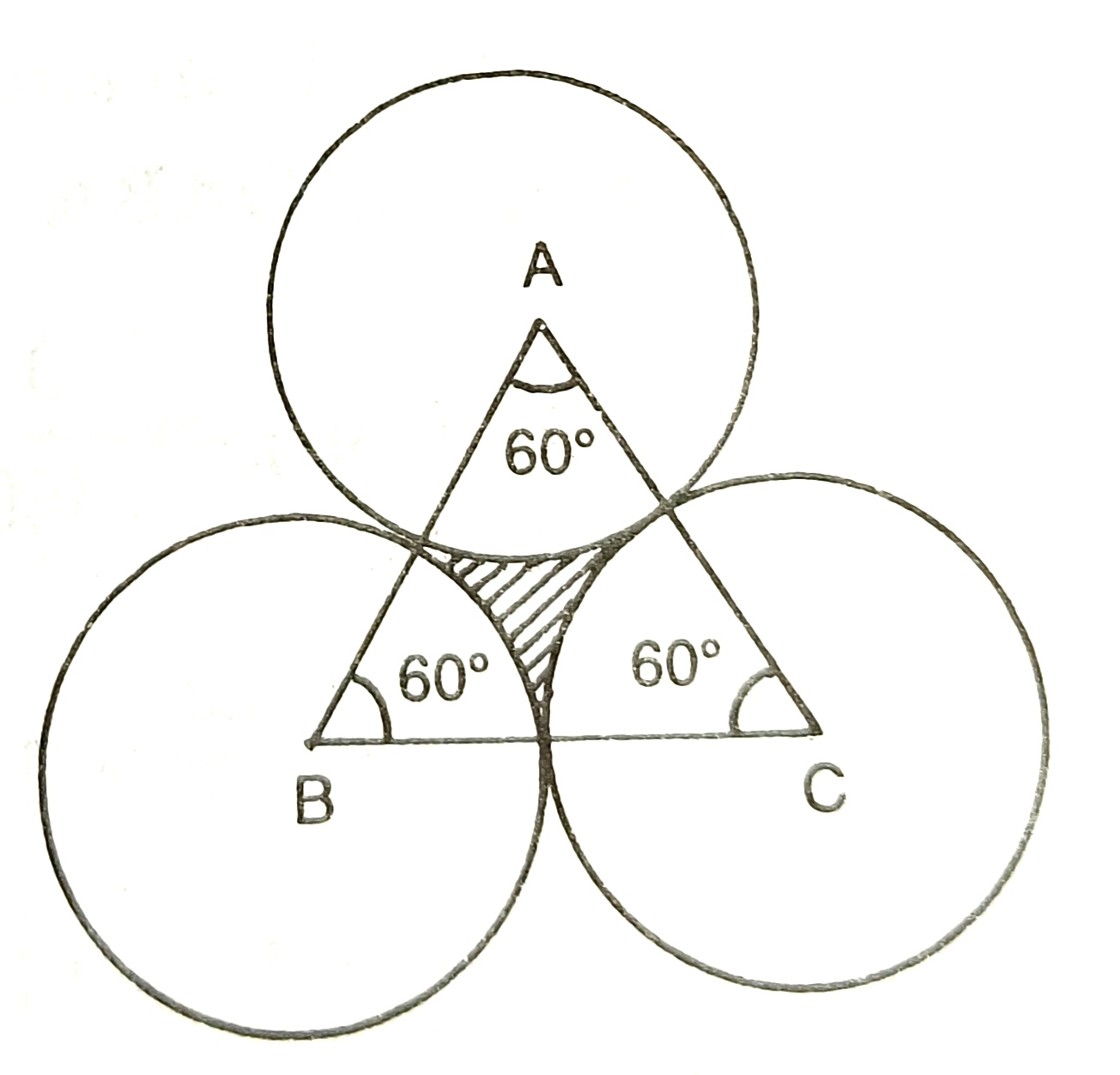
3) There is an equilateral triangle of which the side is 1cm. with all the three corners as centres, circles are described each of radius 1m.   

a) calculate the area common to all the circles circles and the triangles. 1.571m²

b) The area of the remaining portions of the triangle. 0.161m²

4) The area of an equilateral triangle is 17320.5cm². About each angular point as center, a circle is described with radius equal to half the length of the side of the triangle. Find the area of the triangle not included in the circles. 1620.5cm²

5) A horse, left for grazing inside a rectangular enclosure 40mx36m, is tethered to one corner of the field by a rope 14m long. Find the area of the quadrant over which the horse can graze. 154m²

6) How many plants can be planted in a circular garden of circumference 26.40 km if a space of 600 cm² is to be allowed for each plant ? 924

7) A circle of circumference 88cm is cut out of a square sheet of paper of side 30 cm. What is the area of the paper left ? 284cm²


DIAGRAMMATIC QUESTIONS 

1) A garden is made up of a rectangular patch of grass and two semi-circular ponds, as shown in the figure. If the length and width of the rectangular patch are 24 m and 14 m respectively,
 Calculate 
a) the perimeter of the garden.       92m
b) the total area of the garden.        490m²

2)  A rectangle of length 35 cm and width 28cm has a semicircle cut out from each of its two sides, as shown. 
Find the area of the shaded portion.      364cm²

3) If ABCD is a rectangle, 
find the area of the shaded portion.      45.84 m²

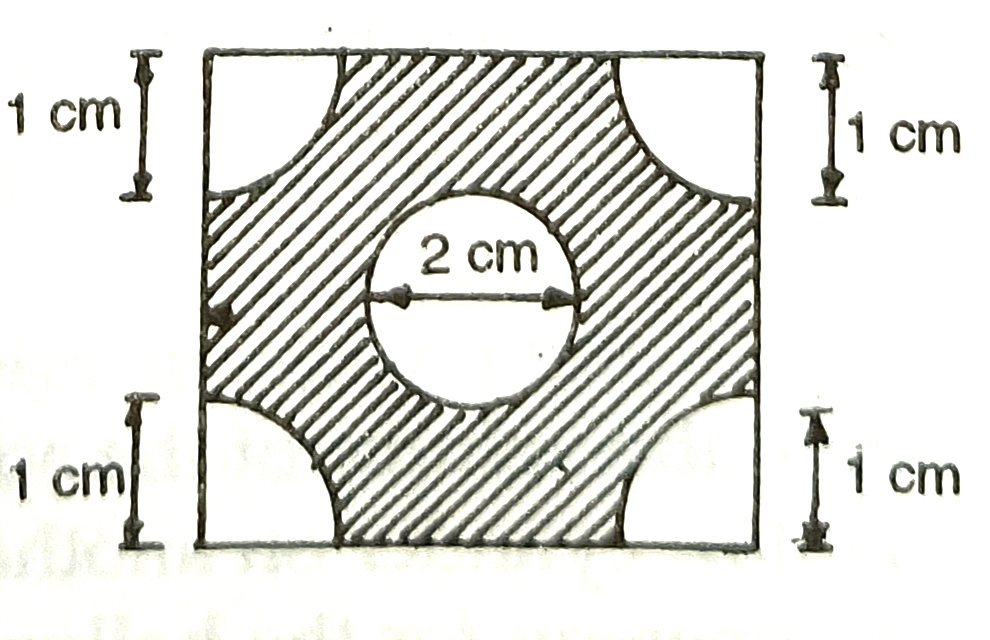
4) Two semi-circle of equal radii are cut out of a semi-circular piece of cardboard. 
Find the area of the shared portion.         38.5 m²

5) A rectangle encloses four circles. The radius of each circle is 7cm. 
Calculate the area of
a) rectangle.         784 cm²
b) the shaded portion.           168 cm²

6) Find area of the shaded portion formed by a semi-circle placed above the square.   
                                                 68.25 cm²
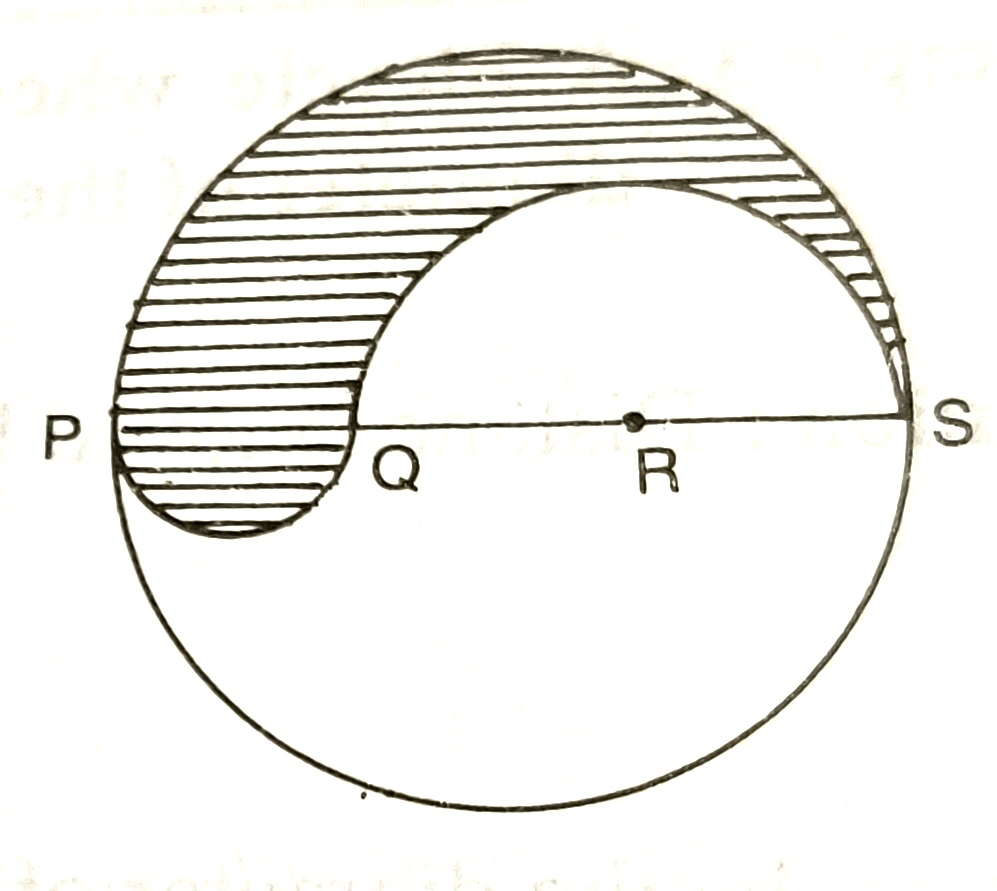
7) PQRS is a diameter circular radius 6cm. The lengths PQ, QR, and RS are equal, Semicirles are drawn on PQ and QS as diameters as shown in the figure. Find the perimeter of the shaded region.    28.3cm

8) The outer circumference of a circular racing track is 220m. The track is everywhere 7m wide. Calculate the cost of levelling the track at the rate of 50 paise per minute.                          ₹693

9) The minute hand of a clock is 10 cm long. Find the area on the face of the clock described by the minute hand between 9 a.m. and 9:35 a.m.   183.33

10) A chord AB of a circle of radius 10 cm makes a right angle at the centre of the circle. Find the area of the major and minor segments.       285.5, 28.5

11) For equal circles, each of radius 5 cm, touch each other as shown in the figure. Find the area between the circles.   21.5

12) The area of an equilateral triangle is 17320.5cm². About each angular point as centre, a circle is described with radius equal to half the length of the side of the triangle. Find the area of the triangle not included in the circles.   1620.5 cm²

13) A horse, left for grazing inside a rectangular enclosure 40 x36 m, is tethered to one corner of the field by a rope 14m long. Find the area of the quadrant over which the horse can graze.           154 m²

14) Calculate the area of the shaded sector region shown in the figure. π= 22/7).                         17.3 cm²

15) It is proposed to add to a square lawn measuring 58m on a side, two circular ends , the centre of each circle being the point of intersection of the diagonals of the square. Find the area of the whole lawn.          4325.14 cm²

16) The perimeter of the adjoining figure, a semi-circle described on AB as diameter is 7.2cm. Find r the radius of the semi-circle. (π=22/7)

17) In the adjoining figure, the area enclosed between the concentric circles is 770 cm². Given that the radius of the outer circle is 21cm, calculate the radius of the inner circle.  

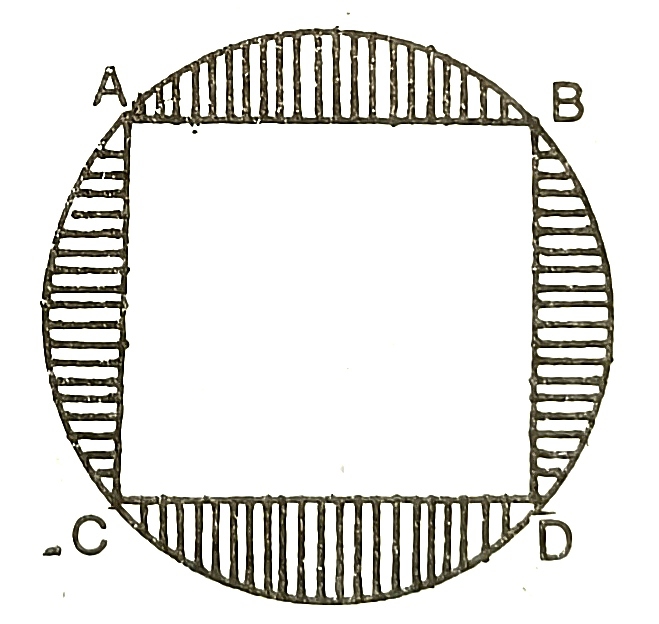
18) In the adjoining figure ABCD is a square inscribed in a circle of radius 7cm. Calculate

a) the area of the circle.

b) the area of the shaded portion. (π=22/7)

19) ABCD is a square of side 4cm. Find the area of the shaded portion. Use π=3.14 and give your answer correct to one place of decimal.

20) The diameter represents the wiper of a car. With the dimensions given in the diagram, calculate the shaded area swept by the wiper. (π=22/7)

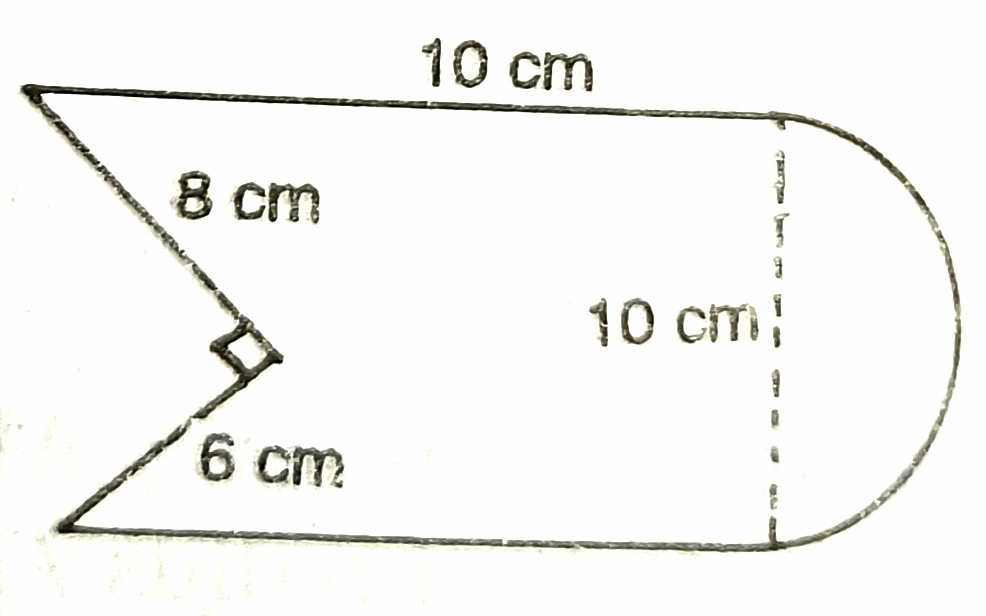
21) Find the area of the adjoining figure in sq cm. Correct to one place of decimal. (π=22/7).

22) Find the perimeter and area of the shaded portion of the adjoining figure, give your answer correct to 3 significant figures. (π=3.14)

23) The adjoining figure consists of a rectangle and a semi-circle. Find its area and perimeter.          532,88
24) The adjoining figure shows the inner boundary of a 600m running track which has two parallel straight lines each of length 200m and two Semicircular ends.
(Assuming π=3.142, calculate the radius of each semi-circular end correct to the nearest 1/100 m).       31.83

25) Four cows are tethered at four corners of a square plot of side 50m, so that just cannot reach one another. What area will be left ungrazed.          535.7m²

26) From the given figure, calculate the area of the shaded portion.       30.57cm²

27) The diagram shows the inner boundary of a 400m running track which has two parallel straights-- each of length 100m and two Semicircular ends. Assuming π=3.142.       31.88m, 9548m²

28) ABCD represents a flower bed. If OA= 21m and OC= 14m, find area of the bed.                       192.5m²

29) A wire when bent in the form of an equilateral triangle encloses an area of 121√3 cm². If the same wire is bent into the form of a circle, find area of the circle.                      346.5cm²

30) In the given figure, diameter of the biggest semi-circle is 108 cm, and diameter of the smallest circle is 36cm. Calculate area of the shaded portion.   1272.9 

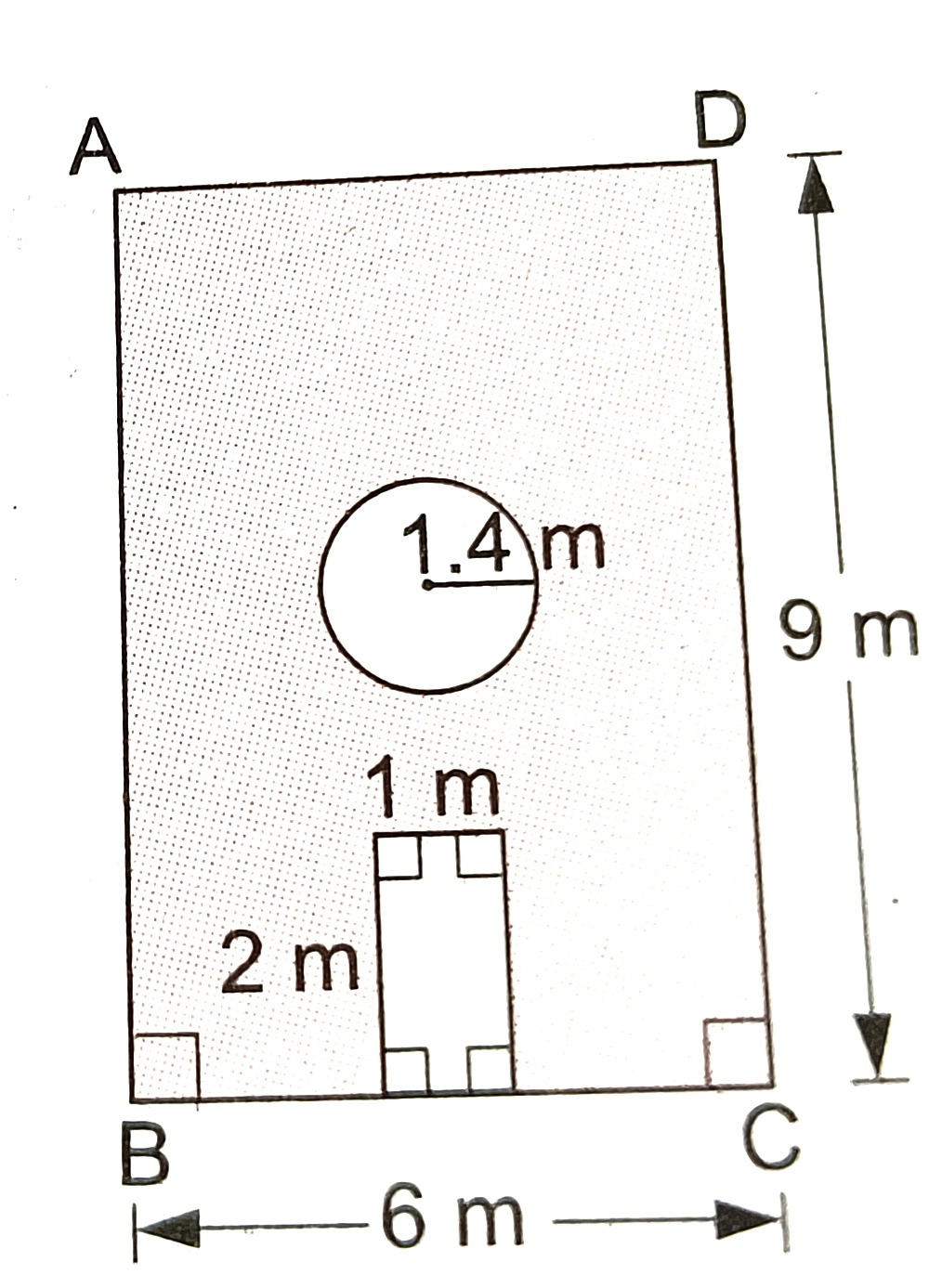
31) In the given figure, the square ABCD is divided into five equal parts all of the same area. The central part is circular and the lines AE, BF, HD lie along the diagonals AC and BD of the square. If AB= 11cm, calculate

a) the radius and circumstance of the central part.     2.78,17.47, 25.37

b) the perimeter of the part ABFE.  

32) The boundary of the shaded portion in the given figure consists of three Semicircular areas, the smaller ones being equal. If the diameter of the larger one is 14cm, calculate:

a) the length of the boundary.        44cm

b) the area of the shaded part.     77cm²

Tuesday, 1 June 2021

MEAN (XI)


*** Find the MEAN of following:

1) 
A) 7, 9, 4, 6, 5.                            6.2

B) Value          Frequency
      1                       7
      2                      11 
      3                      16 
      4                      17 
      5                      26 
      6                      31 
      7                      11 
      8                       1
      9                       1 
     10                      1                4.59

C) Class         Frequency
     0 -  10              4 
    10 - 20              7
    20 - 30              8
    30 - 40              4 
    40 - 50              2                   22.2

D) Height in c.m        Frequency
       130 - 134                  5 
       135 - 139                 15
       140 - 144                 28 
       145 - 149                 24
       150 - 154                 17 
       155 - 159                 10
       160 - 164                   1     145.35 

E) Class              Frequency
     0  -  4                    2 
     5 -  14                   8 
    15 - 19                   6 
    20 - 34                  14 
    35 - 39                   5               21.29 

F) weekly wages(₹)  No.of workers 
     Below 10                     8 
     Below 20                   18 
     Below 30                   45 
     Below 40                   90 
     Below 50                  113 
     Below 60                  120    32.17 

G) Marks                 No. of students 
More than 0                60 
More than 10              56 
More than 20              40 
More than 30              20 
More than 40              10 
More than 50                3         26.5 

H) Value                      No. of boys 
Under ₹10                     245 
₹10 Under ₹20             383 
₹20 Under ₹30             205 
₹30 Under ₹40             89 
₹40 Under ₹50             47 
₹50 Under ₹60             21 
₹60 Under ₹70             10 
Find a) the total turnover b) the mean value of a single order.     ₹19130, ₹19.13, ₹16.67 

I) The mean of the following is 20.5. find the missing frequency.
X: 10   15   20   25    30
F:  5      7    --     12     6                  40 

J) The mean of the following frequency table is 50. But the frequency a and b in classes 20-40 and 60-80 are missing. Find the missing frequencies.
Class              Frequency
0  -  20                 19 
20 - 40                  a 
40 - 60                 32 
60 - 80                  b 
80 - 100               19              28, 24 


K) The A. M calculated from the following frequency distribution is known to be 67.45 inches. Find the value of a.
Height (inches)          frequency
60 - 62                              15 
63 - 65                              54 
66 - 68                               a 
69 - 71                              81 
72 - 74                              24       126

 2) Find Mean by short-cut method

A)  X                F
    2.5               4 
    7.5               5 
   12.5              7 
   17.5            12 
    22.5             7 
    27.6             5.                        16 


3) Find Mean by Step-deviation method.
A)   Marks No. Of students 
            5                   20 
           10                  43 
           15                  75 
            20                 67 
            25                 72 
            30                 45 
            35                 39 
            40                   9 
            45                   8 
            50                   6               22.2 

B) Height (in cm)    No. of boys 
       135-140                  4 
       140-145                  9 
        145-150               18 
        150 -155              28 
        155- 160              24 
        160- 165              10 
        165 -170                5 
        170- 175                2     153.45
 
4) The average marks obtained in an examination by two groups of students were found to be 75 and 85 respectively. Determine the ratio of students in the two groups. If the average marks for all the students was 80.                                      1:1 


5) There are 60 students In a class of which 25 girls. The average weight of 25 girls is 40kg and that of 35 boys is 53kg. Find the mean weight in kg of the entire class.    47.583kg

6) The mean monthly salary paid to all employees of a company was ₹ 5000. The mean annual salary to male and female employees was ₹5200 and ₹4200 respectively. Determine the percentage of males and females employed by the company.                 80%, 20%

7) Mean of 25 observation was found to be 78.4. But later it was found that 96 was misread as 69. Find the correct mean.        79.48 

8) The mean of 40 observations was 160. It was detected on rechecking that the value 125 was wrongly copied as 165 for the computation of the mean. Find the correct mean.  159

9)  The mean age of 40 students is 16 years and the mean  age of another group of 60 students is 20 years. Find out the mean age of all the 100 students combined together.                  18.4

10) The mean of marks obtained in an examination by a group of 100 students is found to be 49.46. The mean of the marks obtained in the same examination by another group of 200 students was 52.32. Find the mean of the marks obtained by both the groups of students taken together.                          51.37 

11)  the mean of 30 values was 150. it was detected on rechecking that the value 165 was wrongly copied as 135 for the computation of the mean. Find the correct mean.  151

12) Two samples of sizes 50 and 100 are given. The mean of these samples are respectively are 56 and 50. Find the mean of size 150 by combining.                                 52

13)  The number of students in section X A and X B are 30 and 35 respectively. The mean scores of students in the mathematics test are as follows:
 XA       XB      XA and XB(combined)
  70        ?             62 
 find the mean score of students of X B.                                          55.14

14) A piece of work was done in 2, 4 and 3 days by thee men. Find the average rate of working.        36/13 


23) you fly to a place X in a Boeing at a speed of 500 miles per hour and come back from X following the same route at a speed of 160 miles per hour. What is the average speed for the to and fro journey.    242.42

24) The A. M and G. M of two numbers are respectively 5 and 4. Find their H. M.                            3.2