Friday, 1 September 2023

SIMILARITY

1) In the given figure, DE|| BC
a) Prove that ∆ ADE and ∆ ABC are similar.
b) Given AD= 1/2 BD, calculate DE, if BC=4.5 cm.                                1.5cm

2) In a ∆ PQR, L and M are two points on the base QR such that angLPQ= ang QRP and angRPM= angROP. Prove that
a) ∆PQR and ∆ RPM are similar
b) QL. RM= PL. PM
c) PQ²= QR.QL

3) In the figure, the median BD and CE of ∆ABC meet at G. 
prove that
a) ∆EGD and ∆ CGB are similar
b) BG= 2GD from (a) above

4) In the figure, P is a point on AB such that AP : PB= 4:3. PQ is parallel to AC.
a) Calculate the ratio PQ: AC, giving reasons for your answer.
b) In ∆ARC, ang ARC = 90° and in ∆ PQS, angPSQ=90°. Given QS = 6cm, calculate the length of AR.                           3:7

5) In the figure, ABC is a triangle. DE||BC and AD/DB =3/2.
a) Write down AD/AB.                   3/5
b) Show ∆ADE and ∆ABC are similar. And write down the ratio of DE/BC.  3/5
c) Show ∆DEF and ∆CFB are similar. 

6) Calculate the remaining sides of a triangle whose shortest side is 5cm and which is smaller to a triangle with sides 4cm, 7cm and 8cm.                8.75, 10

7) A vertical pole 4m high casts a shadow 1.6m long at the same moment as a flagstaff casts a shadow 12m long. Calculate the height of the flagstaff.   30

8) In a triangle ∆ABC, D and E are points on AB and AC respectively such that DE||BC, prove that ∆ADE and ∆ABC are similar.
If BC =12cm, BD = 7cm, and AD = 8cm,.find the length of DE.              6.4

9) ∆ABC and ∆PQR are similar and ang C=90. If AC= PQ =5cm and QR = 4cm, calculate the length of AB and BC.  17/2, 20/3 

9) In a ∆ABC, D is a point on BC such that ang BAD= ang ACB, AB =6cm, AD =5cm and BD = 4cm. If CD = x and AC= y, find x, y.                              5,7.5

10) In the adjoining figure find 
a) AB b) BC.              2.5, 6
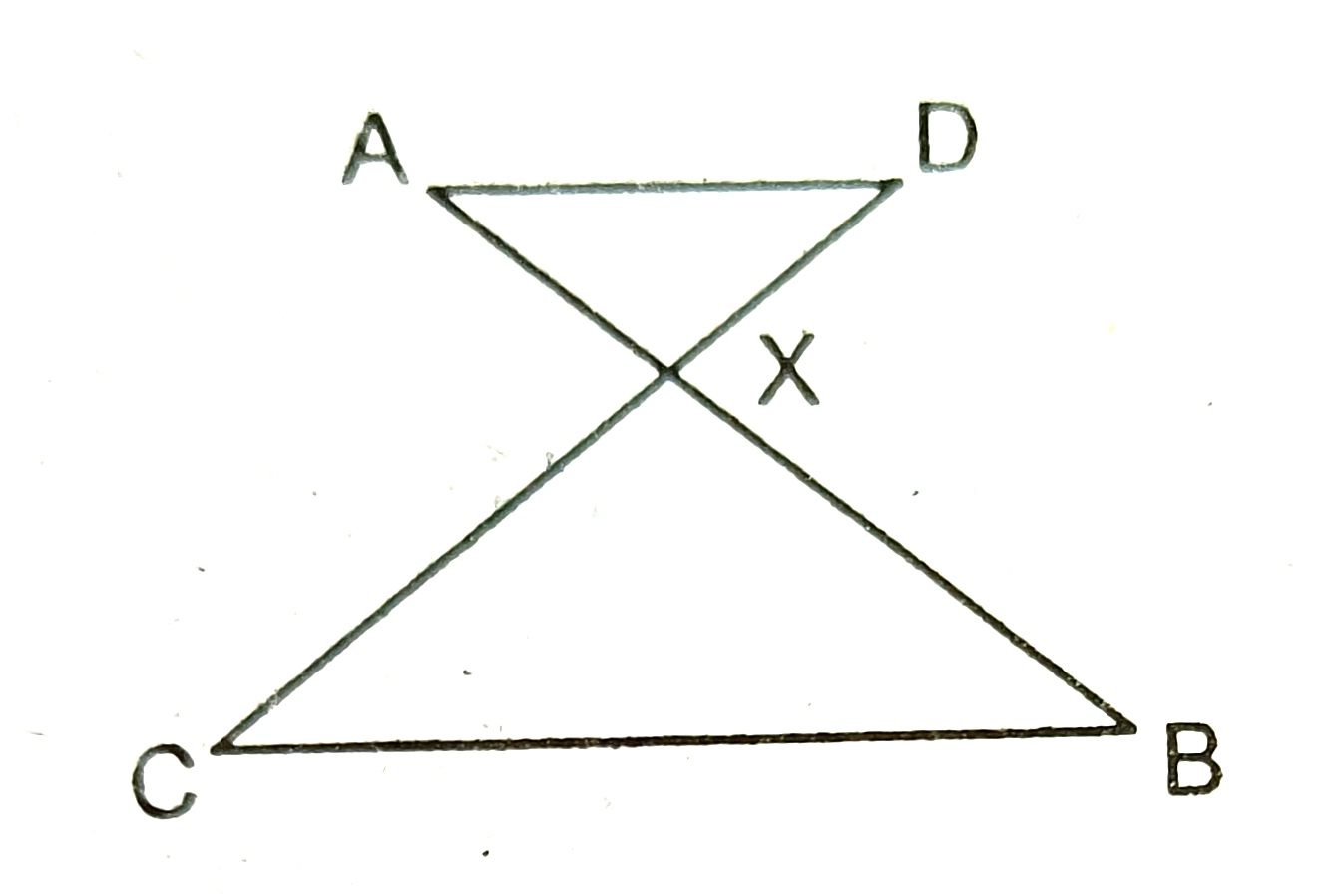
11) In figure, AB and CD Intersect at X. If  AX/BX= DX/CX, prove that AD||BC. 
12) The perimeter of two similar triangles are 40cm and 25cm. If a side of the first triangle is 15cm, find the length of the corresponding side of the second triangle.            75/8

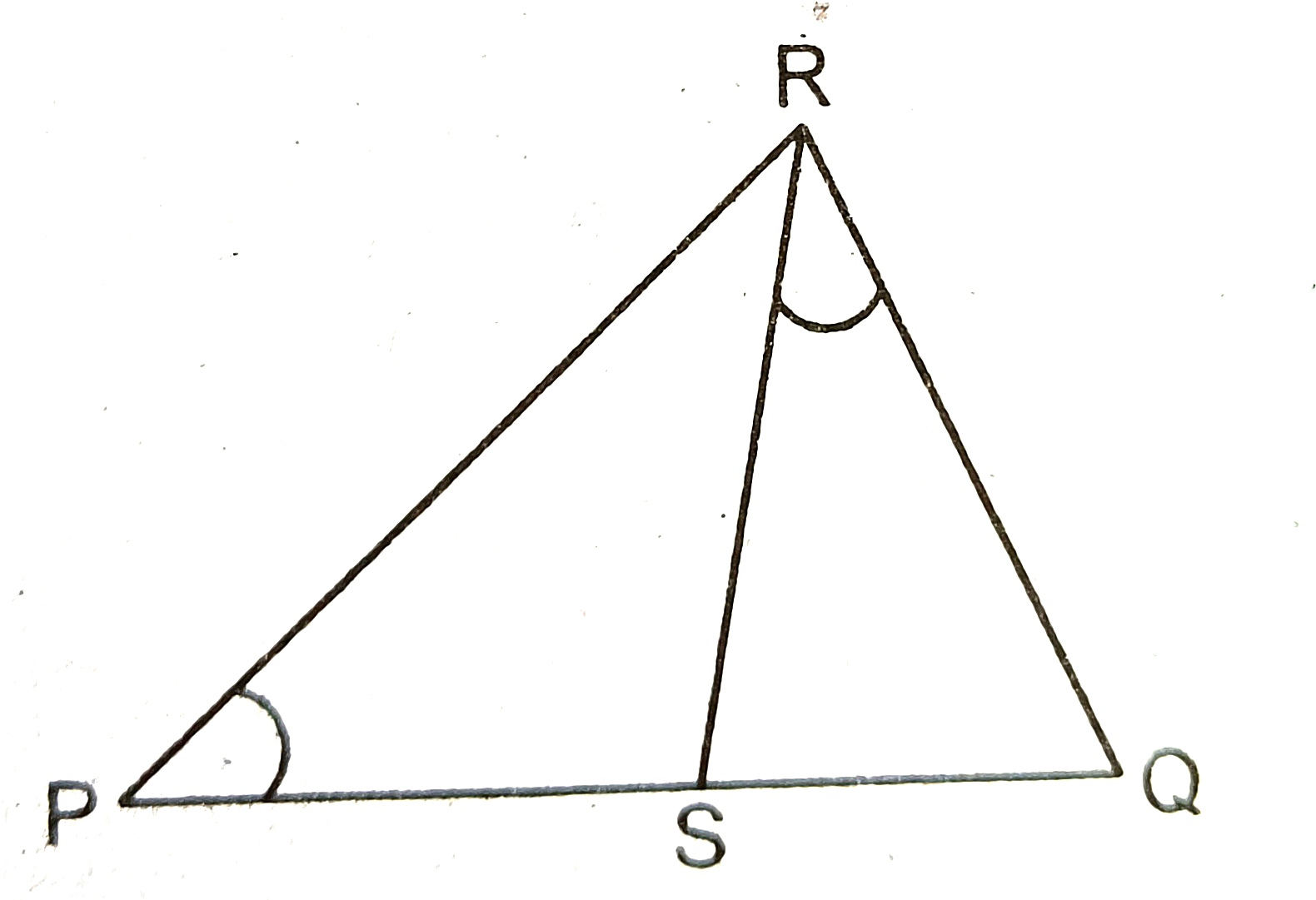
13) In figure, angRPS= angSRQ. show that ∆PQR similar to ∆RQS.
14) Two isosceles triangles have their vertex angle equal. Prove that the triangles are similar.

15) The perimeter of two similar triangles ABC and PQR are respectively 32 and 24cm. If PQ=12cm, find AB.    16

16) D is a point on side BC of a ∆ABC such that angADC and ang BAC are equal. Prove that CA² = DC x CB.

17) In the figure ST||QR, PS=4cm, QS=5cm and PR=8 cm.
Find 
a) PT b) TR c) QR/ST.      32/9, 40/9, 9/4

18) In figure DE || BC and BD || FE, AD=5cm, and DB=6cm, AE=3cm
Calculate  EC.                                     3.6

19) If one diagonal of a trapezium divides the other diagonal in the ratio 1:2 prove that one of the parallel sides will be half the other.

20) PQRS is a parallelogram, M is the midpoint of PS. RM intersect SQ in X. RM produced meets QP produced Y prove XY = 2RX

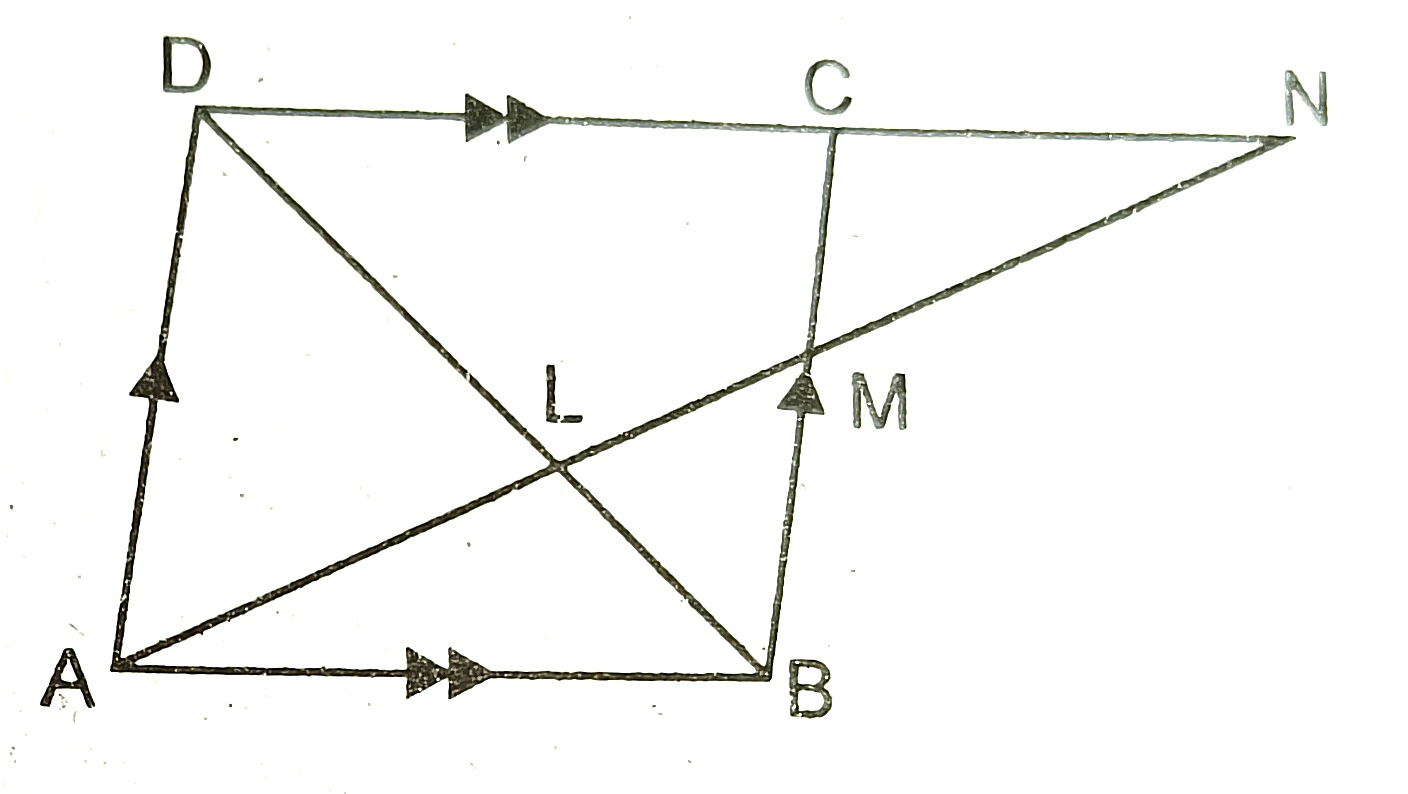
21) ABCD is a parallelogram. A straight line is drawn through A meeting lines BD at L and BC at M and DC produced at N. Prove that AL/LN= AM/AN.
22) ABCD is a parallelogram. E is any point on BC . AE and BD intersect at O. Prove that AO x OB = OD x OE.

23) ABCD is a trapezium in which AD|| BC. AC and BD Intersect at E. If ∆ AED similar to ∆BEC, show that AB = DC.

24) PQR is an equilateral triangle. The base QR is produced both ways to X and Y such that QR = QX = RY. If PX and PY are joined , show that the triangles PQX and XPY are equiangular and hence, show PX² = 3QR².

25) AF is the median of ∆ABCb. FD and FE are bisectors of angAFB and angAFC meeting AB and AC at D and E respectively. Show that DE||BC.
26) In figure, ABC is a right triangle with angABC =90°. BD perpendicular to AC, DM perpendicular to BC and DN perpendicular to AB, prove that
a) DM²= DN x MC
b) DN²= DM x AN.

27) In the adjoining figure, LM is parallel to BC. AB = 6cm, AL =2cm and AC =9cm.
Calculate the length of CM.                6

28) In figure, ABCD is a trapezium with AB|| DC and AB = 1/2 DC. Prove that O is the point of trisection of diagonals AC and BD.

29) In the figure alongside, PQRS is a parallelogram. PQ =16cm, QR = 10cm. L is a point on PR such that RL : LP = 2:3. QL produced meets RS at M. And PS produced at N .
a) Prove that ∆RLQ and ∆PLN are similar. Find PN.                        15
b) Name a triangle similar to Triangle RLM. Evaluate RM as a fraction.      32/3

Saturday, 19 August 2023

RATIO & PROPORTION (C)

EXERCISE -A

1) Find the ratio between
a) 60 paise & &1.35.                            4:9
b) 4 months & 1 year 6 months.        2:9
c) 60cm & 2.4m.                                  1:4
d) 1.5kg & 600gms.                             5:2


2) Which ratio is greater : 17:21 or 23:28?                                23:28> 17:21

3) Arrange the following ratios in the ascending order:
A) 19:21, 13:15, 11:24.         11:24, 13:15 , 19:21

4) Arrange the following ratios in the ascending order:
7:12,11:16,13:18.               13:18, 11:16, 7:12

5) Which is Greater ratio (x + 4y)/(x + 5y) or (x + 5y)/(x +6y) ?          (x + 5y)/(x +6y)

6) Find the following:
a) Duplicate ratio of 2√a : 3√b.      4a:9b
b) Triplicate ratio of 2x: 3y.          8x³:27y³
c) sub duplicate ratio of 16x²: 25y².     4x: 5y
d) sub-triplicate ratio of 27a³: 125b³.  3a: 5b
e) The reciprocal ratio of 9:11.        11:9

7) Compound ratio of 
a) duplicate ratio of 5:6, the reciprocal ratio of 25:32 and sub-duplicate ratio of 81:64.               1:1

b) x: 3y and 2a : b/3.                   2ax: yb

c) x²/2 : y²/3 and the duplicate ratio of 1/x : 1/y.                               3:2

d) 3a: 4b and the sub-duplicate ratio of 4/9a² : 1/16b².                2:1

e) 2y²: 3x² and the triplicate ratio of x : y.   2x: 3y

f) duplicate ratio of 5:6, reciprocal ratio of 25:42 and the sub-triplicate ratio of 216:343.                         1:1

8) a) If x: y be the sub-duplicate ratio of (x - a): (y - a), then find the value of xy/(x +y).              a

b) If (3x -9):(5x+4) is the triplicate ratio of 3:4, find the value of x.            12

c) If A: B= 4:9 and B: C= 6:5, find A: C.      8: 15

d) If A: B= 3:4 and B: C= 6:5, find A: B:C.     9: 12:10

e) If A: B= 2:3 and B: C= 4:7, find A: B:C.     8: 12:21

f) If A: B= 1/4:1/5 and B: C= 1/7:1/6, find A: B:C.            15: 12:14

g) 3A =4 B = 6C, find A: B : C.           4:3:2

h) If (2x +5y): (5x -7y)= 5:3, Find x: y.    50:19

i) If (4x +3y): (6x +5y)= 11:17, Find x: y.  2:1

j) If a: b= 2:3 find (5a+ 8b): (6a - 7b).  49:9

k) if (6x² - 3y²):(x² + y²) is equal to 6: 25 find the value of x:y .                 3:4


9)a) What number must be added to each term of the ratio 3:5 to make it 11: 12?   19

b) What same number should be added to both terms of 7:12 to get the ratio 2:3?     3


10) a) The ages of A and B are in the ratio 7:8. 6 years ago, their ages were in the ratio 5:6. Find their present ages.   21,24

b) A ratio is equal to 3:4. If its consequent is 144, what is its antecedent?         108

c) Two numbers are in the ratio 5: 7. If 8 is subtracted from each, the ratio becomes 3:5. Find the numbers.   20,28

d) What should be subtracted from each term of the ratio 4:9 so that it becomes 1:3.                3/2

e) Two numbers in the ratio 3:5. If 8 is added to each number, the ratio becomes 2:3. Find the numbers.   24,40

f) Find the number which bears the same ratio to 7/33 that 8/21 does to 4/9.  2/11

g) Work done by (x- 3) men in (2x + 1) days and the work done by (2x + 1) men in (x + 4) days are in the ratio 3:10. Find the value of x.           6

h) the cost of production of radio set is ₹900, which is divided between material, labour and overheads in the ratio 3:4:2. Calculate the cost of material used in the radio set.              300

i) A sum of money is divided in the ratio of 3:5. If the larger part is ₹3125, find the smaller part.             1875

j) Divide ₹2600 among A, B and C in the ratio 1/2: 1/3: 1/4.              1200,800,600

k) when the fair of a certain journey by an airline was increased in the ratio 5:7, the cost of a ticket for the journey becomes ₹1421. Find the increase in the fare.           406

l) Sum of the two numbers is 38 and their difference is 2. What is the ratio between the numbers?              10:9 

m) the ratio of the males to females in a committee of 48 members is 31. How many more ladies b added to the committee so that the ratio of the males to females may be 9:5 ?                  8

n) a bav contains ₹142 in the form of Rs 1, 50 paise and 20 paise coins in the ratio of 3:5:8. Find the number of coins of each type.               60,100,160

o) A, B and C play cricket. The rund scored by A and B respectively are in the ratio 3:2. B's runs to C's runs are also in the ratio 3:2, and together they score 342 runs. How many runs did each score ?        162, 108, 72

p) Ages of two persons A and B are in the ratio 4:3. Five years hence the ratio of their ages will change to 9:7. Find their present ages.                40, 30yrs

q) In a mixture of 45 litres, the ratio milk to water is 13:2. How much water must be added to this mixture to make the ratio of milk to water as 3:1?    7 litres

r) In an examination, the ratio passes to failure was 4 :1. Had 30 less appeared and 20 less passed, the ratio of passes to failure would have been 5:1. How many students appeared for the examination ?                             150 


PROPORTION 


EXERCISE-B

1) Find x, when
a) If x², 4 and 9 are in continued proportion.                                           4/3
b) 1:3:: x:7.                                           7/3
c) x: 1.5 ::3:5.                                      0.9
d) 2.5 :1.5:: x :3.                                    5
e) x: 50:: 3:2 .                                       75

2) Find the third proportional to:
a) 9, 6.                                                   4
b) 8/3, 4.                                              6
c) 1.6, 2.4.                                           3.6
d) 0.24, 0.6.                                        1.2
e) (2 + √3),(5 + 4√3).                (26+7√3)
f) [a/b + b/a] and √(a²+b²).                 ab

3) Find the fourth proportional to:
a) 3, 12 and 15.                                 60
b) 1.4, 3.2 and 7.                              16
c) 1.5, 4.5 and 3.6.                         10.8
d) (a²- ab +b²),(a³+ b³) and (a - b).   a²- b²

4) Find the mean proportion of :
a) 5 and 80.                                          20
b) 2.5 and 0.9.                                      1.5
c) 1/12 and 1/75.                               1/30
d) (8 - 4√3) and (6 + 3√3).                 2√3

5) a) What number should be subtracted from each of the following numbers 23, 30, 57 and 78 so that the reminders are in proportion ?                          6

b) what least number must be adde to each of the number 16, 7, 79 and 43, so that the resulting numbers are in proportion ?                                         5

c) Find two numbers whose mean proportional is 16 and the third proportion is 128.                              8,32

d) What number should be added to each of the number 12, 22, 42 and 72 so that the resulting number maybe proportion.                                             3

e) If (x - 2), (x + 2), (2x + 1) and (2x + 19) are in proportion, find the value of x.      4

f) if (x + 5) is the geometric mean between (x+ 2) and (x + 9), find the value of x.                     7

5) If x/a = y/b = z/c then find the value of 

6) a) [(a²x²+ b² y²+ c² z²)/(a³x + by³+ c³z)]³/²                     √(xyz/abc).

b) If a/b = c/d = e/f, then value of  (a²+d² + f²)/(a²+ c² + e²) is.         (ab + cd + ef)².

c) (a³+c³)²/(b³+ d³)².                          e⁶/f⁶

d) (pa³+qc³+ re³)/(pb³+ qd³+ rf³).  ace/bdf

7) a, b, c, d are in continued proportion, find the value of 
a) (a-b)³/(b-c)³.                                    a/d

b) √(2a²+7b²)/√(2c²+ 7d²).       (a+ b)/(c+ d) 


EXERCISE- C

1) Find the value of a:b:: c: d from the following:

a) (4a+5b)(4c-5d) = (4a-5b)(4c+5d)

b) (pa+qb):(pc+qd) :: (pa-qb):(pc- qd)

c) (5a+6b)/(5c+6d)=(5a-6b)/(5c-6d).

d) (3a+4b)/(3c+4d)=(3a-4b)/(3c-4d).

e) (a+3b+2c+6d)/(a-3b+2c-6d) = (a+3b-2c- 6d)/(a-3b-2c+6d)

f) (a+b+c+d):(a+b-c-d) :: (a-b+c- d):(a-b-c+d).

g) (2a+2b-3c-3d)/(2a-2b-3c+3d) = (a+b- 4c- 4d)/(a-b-4c+4d).

h) If a: b:: c: d, Prove the following:

i) (2a+5b)/(2a-5b) = (2c+ 5d)/(2c-5d).

j) (5a+11b)/(5c+11d) = (5a-11b)(5c-11d)

k) (2a+3b)(2c-3d) = (2a-3b)(2c+3d)

l) (3a - 5b)/(3c+5d)=(3c- 5d)/(3c+ 5d)

m) (la+mb):(lc+ md) :: (la-mb): (lc- md).


2) a) If x= 2ab/(a + b) then find the value of (x+a)/(x -a) + (x+ b)/(x-b).             2

b) If x= 6ab/(a + b) then find the value of (x+3a)/(x -3a) + (x+ 3b)/(x- 3b).           2

c) If (x³+3x)/(3x²+1) = 341/91tnen find the value of x.                                        11

3) Find x from the following:

a) {√(2- x) + √(2+x)}/{√(2- x) - √(2+x)}= 3.                 -6/5

b) {√(1+ x) + √(1-x)}/{√(1+ x) - √(1- x)}= a/b.                2ab/(a²+ b²)

c) {√(a+ x) + √(a-x)}/{√(a+ x) - √(a- x)}= c/d.                   2acd/(c²+ d²)

d) {√(x+4) + √(x -10)}/{√(x +4) - √(x -10)}= 5/2.                               263/20

e) {(a- x)/(a+x)}³ =16{(a+ x)/(a-x)}.            -a/3, -3a

f) (1+ x+ x²)/(1-x+ x²)=62(1+x)/63(1-x).     1/5

g) {√(x +5) + √(x -16)}/{√(x+5) - √(x -16)}= 7/3.               20


4) a) If {√(2a +1) + √(2a -1)}/{√(2a+1) - √(2a -1)}= x. Then find the value of x²- 4ax +1.                               0

b) {√(b +3a) + √(b -3a)}/{√(b+3a) - √(b -3a)}= x, then find the value 3ax²- 2bx + 3a.                              0.

c) {3√(m +1) + ³√(m -1)}/{³√(m+1) - ³√(m -1)}= x then find the value of x³- 3x²m+ 3x is                                      m

d) {√(a +3b) + √(a -3b)}/{√(a+3b) - √(a -3b)}=x, then 3by²- 2ax is.                      3b 

Exercise -D

1) Find the third proportional to 15, 20.

2) Divide ₹1320 among 7 men, 11 women & 5 boys so that each women may have 3 times as much as a boy, and a man as much as a woman and a boy together. Find how much each person receives.

3) How many one rupees coins, fifty-paise coins & twenty-five paise coins of which the numbers are proportional to 5/1, 3 and 4 are together worth & 210 ?

4) In 40 litres mixture of milk and water in the ratio of milk and water is 3:1. How much water should be added in the mixture so that the ratio of milk to water becomes 2:1 ?

5) Side of a hexagon becomes 3 times. Find ratio of areas of new and old hexagons.

6) find the number which when added to the terms of the ratio 11: 23 makes it equal to the ratio 4:7.

7) the sum of two numbers is 84. if the two numbers are in the ratio 4:3, find the two numbers. 48, 36

8) if 4a = 3b, find (7a+9b):(4a+5b). 57: 32

9) the number of red balls and green balls in a bag are in the ratio 16:7. if there are 45 more red balls then green balls. find the number of green balls in the bag. 45

10) what least number must be added to each of a pair of numbers which are in the ratio 7:16 so that the ratio between the terms become 13:22 ? 6

11) A number is divided into four parts such that 4 times the first part, 3 times the second part, 6 times the third part and 8 times the fourth part are equal. In what ratio is the number divided? 6:8:4:3

12) Divide 3150 into four parts such that half of the first part, a third of the second part, a fourth of the third part is equal to one- twelfth of the fourth part. 300, 450, 600,1800.

13) if x: y= 4:3, y: z= 2:3, find x:y:z. 8:6:9

14) If a/b = 4/5, then find (2a²-3b)/(7a+6b²). Can't determined

15) Two numbers are in the ratio 4:5, if 7 is added to each, the ratio between the numbers becomes 5: 6. find the numbers. 28, 35

16) Find x: if x+2 : 4x+1 :: 5x+2 : 13x+1. 0 or 2.

17) The total monthly sales of two companies A and B are in the ratio 2:3 and their total monthly expenditures are in the ratio 3:4. Find the ratio of the profits of the two companies given that company A's profit is equal to a fifth of its sales. 6:13

18) If a: b= 3:7, what is the value of (4a+5b)/(2a+2b).
A) 47/20 B) 36/24 C) 56/32 D)10/4 E) none.

19) If a: b= 2:3, b: c= 4:3 , and If c: d= 2:3, find a: b: c: d.
A) 8:12:9:27 B) 16:24:18:27
C) 18:27:36:8 D) none 

20) Vipin's present is twice what the age of Kishor was one year ago. What is the sum of their present ages (in years), if the ratio of the sum of their present ages to the difference of their present ages is 19:5?
A) 21 B) 19 C) 24 D) 34 

21) The weight of the Bimal and Basu are in the ratio 2:3 and the weights of Basu and Bali are in the ratio 4:3. what is Basu's weight (in kg) if the sum of the weights of Bimal, Basu and Bali is 203 kgs ?
A) 84 B) 76 C) 49 D) 65 E) none 

22) the ratio of the number of boys to the number of girls in school is 7:3. If an additional 15 girls were to join the class, the ratio of the number of boys to the number of girls would become 2:3. what is the initial number of the girls in the class ?
A) 4 B) 6 C) 12 D) 5 E) none

23) if k= (a+c)/(b+d) = (c+r)/(f+d) = (a+e)/(b+f) when all quantities are positive, then which of the following must be true ?
A) k= e/f B) k= a/b C) k= c/d D) All of the above E) none

24) if 3 is subtracted from the numerator and 5 is added to the denominator of a fraction, the new fraction formed is 1/2. if 2 is added to the numerator of the initial fraction, the ratio of the new numerator to the denominator becomes 1:1. find the original fraction.
A) 11/13 B) 18/23 C) 13/15 D) 5/14 E) none 

25) The ratio of the Ahmed's age to Mohammad's age is the same as the ratio of the ages of their respective elder brothers. The ratio of the difference of the ages of the ages of Ahmed and Mohammad to that the difference of the ages of their respective brothers is 1:2. what is the ratio of the sum of the ages of their respective brothers to the sum of the ages of the Ahmed and Mohammad?
A) 2:1 B) 4:1 C) 3:1 D) √2:1 

26) Three different types of balls priced at ₹5, ₹8 and ₹13 per piece are displayed in three different boxes by a trader. Mr Paul bought from this shop all three types of balls spending a total sum of ₹768. The numbers of the balls ihe bought, taken in the order in which the prices are mentioned above, are in the ratio 5:4:3. How many balls of the costliest veriety did he buy ?
A) 104 B) 64 C) 24 D) 72 

27) the mean proportional between two numbers is 9 and third proportion of the two numbers is 243. find the larger of the two numbers.
A) 27 B) 81 C) 9 D) none 

28) If 3x - 4y +2z= 0 and 4x - 2y-z= 0, find x:z: y.
A) 8:10:11 B) 8:11:40
C) 11:40:8 D) 8:40:11

29) A person with him a certain number of weighing stones of 100gms, 500 gms and 1kg in the ratio 3:5:1. If a maximum of 5 kg can be measured using weighing stones of 500 gms alone, then what is the number of 100 gm stones he has ?
A) 6 B) 3. C) 9 D) 5

30) What must be subtracted from p and added to q so that the ratio of the resultant becomes 1:3.
A)(p+q)/3 B) (3p-q)/4 C) (p-q)/(p+q) D) (q-3p)/4

31) p,q,r,s, n and m are positive integers such that 4p= 5q= 6r= 12s= 8n = 9m. Which of the following pairs contains a number, which is not integer?
A) {pq/54, (m+n)/17}
B) {q/9, (rs/p}
C) {(r-s)(n-m),(q+s)/17}
D) {p/m, m/q}

** the amount used to purchase one litre of petrol can be used to purchase 3 litres of diesel of 5 litres of kerosene. Out of certain amount, ₹510 is spent on diesel.
32) how much is spent on kerosene if equal volumes of the 3 liquids are purchased with the total amount ?
A) ₹300 B) ₹306 C) ₹382 D) ₹354

33) what will be the amount spent on petrol if the total amount referred in Q. 56 is spent to purchase equal volumes of petrol and kerosene only ?
A) 1250 B)1275 C)1955 D) 1360

34) some apples are divided among 4 people Karan, Kiran, Kumar and Khanna. the ratio of the number of apples given to Kiran to the total number of apples given to Karan and Khanna is 1:2. the ratio of the number of apples given to Kumar to that of the remaining apples is 2:5. Khanna gets 2 apples more than Kiran, Karan gets half the number of apples that Kumar get. What is the total number of apples distributed ?
A) 21 B) 18 C) 19 D) 24

35) If (2x²-4x+3)/(4x-3) =(2x²-3x+5)/(3x-5) Find the value/s of x.
A) 0 B) 2 C) -2 D) both A and C

36) A certain number is added to each of a pair of a numbers which are in the ratio 4:7. The sum of the resulting numbers is 75 and their ratio (taken in the same order as mentioned above) is 8:17. What is the number added ?
A) -12 B) 9 C) -13 D) 8 

37) A garrison of 900 soldiers had food-stock sufficient for 30 days when the rate of consumption is 2.5 kg/day/soldier. After some days of consumption at the rate, 300 soldiers were transferred to another garrison and the balance food lasted for 25 days for the remaining soldiers. If the rate of consumption of the remaining soldiers was 3.0 kg/day/soldier, after how many days from the start, were the soldiers transferred?
A) 12 B) 10 C) 8 D) 15

38) Eight farmers take 4 hours to plough 12 acres of land. What is the area of land that will be ploughed, If 12 farmers work for 14 hours at the same efficiency as in the previous case ?
A) 52 acres B) 63 acres D) 58 acres D) 65 acres

39) Divide 66 into three parts such that the sum of the first two parts equals the third part and the second part is 3 less than twice the first part. What is the ratio of the parts are arranged in the ascending order ? 
A) 14:17:19 B) 5:9:11 C) 11:7:4 D) 4:7:11

40) The speed of a locomotive without any wagons attached to it is 40 kmph. It diminishes by a quantity which is the proportional to the cube root of the number of wagons attached. if the speed of the locomotive is 34 kmph when 27 Wagon are attached, what is the maximum number of wagons that can be attached if the condition is that speed should not be fall below 30 kmph ?
A) 64 B) 125 C) 216 D) 343

41) A certain amount of money is divided among nine brothers. The second brother gets ₹2 more than twice the amount given to the first brother. the third brother gets ₹3 more than the thrice the amount given to the first brother, and so on till the ninth brother. If the ratio of the amount with the ninth brother to the amount with the first brother is 10:1, how much did the fifth brother get (in rupees)?
A) 100 B) 50 C) 90 D) 75 

42) Manoj and Shiva, who are colleageues in an office, have their monthly savings in the ratio 2:3. Manoj spends two-thirds of his income every month. if the ratio of their monthly income is 3:4, what is the ratio of their expenditures?
A) 3:2 B) 4:5 C) 4:3 D) 5:3 

** A test of 60 minutes contains questions on mathematics and English only. the time taken to solve a mathematics question is twice the time taken to answer an English question and the ratio of time taken to solve the mathematics questions to time taken to answer all English questions is 8/7.
43) what is the ratio of the number of English Questions to that of mathematics ?
A) 11/7 B) 7/4 C) 9/4 D) 7/5

44) if the total number of questions is 22. how many English questions can be answered in 18 minutes ?
A) 8 B) 10 C) 11 D) 9


Miscellaneous -1

1) If a: b = 5:3, find (5a+ 8b): (6a - 7b).         49:9

2) Two numbers are in the ratio 3:5. If 8 is added to each number, the ratio becomes 2:3. Find the numbers.    24,40

3) The cost of production of a radio set is Rs900, which is divided between material, labour and overheads in the ratio 3:4:2. Find the cost of material used in the radio set.     Rs300

4) Find the ratio between 1.5kg and 600gm.      5:2

5) Arrange the following ratios in the ascending order:
19:21; 13:15; 11:24.

6) Arrange the following ratios in the descending order
7:12; 11:16; 13:18

7) If A: B= 4:9 and B: C= 6:5, find A: C.       8:15

8) If A: B= 3:4 and B: C= 6:5, find A: B: C.          9:12: 14

9) If A: B= 1/4: 1/5 and B: C= 1/7: 1/6, find A: B: C.          15::12::14

10) If 3A: 4B: 6C, find A: B: C.         4:3:2

11) What number must be added to each term of the ratio 3:5 to make it 11:12?     19

12) The ages of A and B are in the ratio 7:8, six years ago, their ages were in the ratio 5:6. Find their present ages.       21,24 years 

13) A ratio is equal to 3:4. If its consequent is 144, what is its anticedent?     108

14) Find the number which bears the same ratio to 7/33 that 8/21 does to 4/9.     2/11

15) A sum of money is divided in the ratio of 3:5, if the larger part is Rs 3125, find the smaller part.      Rs1875

16) Divide Rd2600 among A, B, C in the ratio 1/2, 1/3, 1/4.     1200, 800, 600

17) Sum of two numbers is 38 and their difference is 2. What is the ratio between the numbers.      10:9


Wednesday, 9 August 2023

QUADRILATERAL (VIII)


1) The angles of a quadrilateral are 4x, 15x, 7x, 10x. Find the smallest and the largest angles of the quadrilateral.   40, 150

2) If angles A, B, C, D of a quadrilateral ABCD, taken in order, are in ratio 3:7:6:4 then find the angles.     54,136,108,72

3) If two angles of a quadrilateral are 40 and 110 and the other two are in the ratio 3:4, find these angles.    90,120

4) If the angles of a quadrilateral, taken in order, are in the ratio 1:2:3:4. Find the angles.       36, 72,108,144

5) Three angles of a quadrilateral are 75,90 and 75. Find the fourth angle.   120

6)

INSTALMENTS

ALGORITHM
STEP.1 Obtain Cash price (CP) of the article.
Step. 2  Obtain cash down payment (DP).
Step 3.  Compute balance due (BD) by using
      BD = CP - DP
Step 4.  Obtain the given quantities, e.g.
    P= Value of each installment
    n= Number of installments.
    R= Rate of interest. etc.,
Step 5.  Assume the unknown quantity and use the following formula to compute it.
 (1+ nR/1200) BD= {1+ (n-1)R/2400} nP.

Remark: Sometimes in an installment buying plan the balance due is paid in just one installment after a certain number of months (say n). In such cases,  we have 
   Amount of the balance due= Volume of the installment.
=> BD + (BD x R x n)/1200= value of the installment.
=> (1+ nR/1200)BD = Value of the Installment.

EXERCISE- 1

1) A briefcase is available for Rs 1600 cash or for ₹600 cash down payment and ₹1080 to be paid after 6 months. Find the rate of interest charged under the installment plan.                         16%

2) A room heater is sold for ₹440 Cash for ₹200 cash down payment together with ₹244 to be paid after 1 month. Find the rate of interest charged in the installment scheme.                     20%

3) One can purchase a room cooler for ₹2400 cash or for ₹1200 Cash down payment and two monthly installments of ₹610 each. Find the rate of interest charged under the installment plan.   13.40%

4) A scooter can be purchased for ₹2800 Cash or for ₹7400 cash down payment followed by 4 equal monthly installments ₹5200 each. Find the rate of interest charged under the installment plan.   4.69%

5) A tractor is sold for ₹450000 Cash or for ₹150000 cash down payment together with 10 equal installments of ₹32000 each . Find the rate of interest charged under the installment plan.   15.38%

6) An electric generator is sold for ₹39000 cash or for 25% cash down payment and 8 equal monthly installments of ₹3900 each. Calculate the rate of interest charged.      18.75%

7) A videocamera can be purchased for ₹60000 cash or for 20% cash down payment and ₹48000 in equal monthly installments of ₹5000 each. What rate of interest does the buyer pay ?    9.41%

8) A Xerox machine is available for ₹78000 cash or for ₹ 100/3% cash down payment and 11 equal monthly installments of ₹4900 each . Calculate the rate of interest charged .    7.54%

9) A ceiling fan is marked at ₹970 cash or for ₹210 Cash down payment followed by 3 equal monthly Installments. If the rate of interest charged under the installment plan is 16% per annum, find the monthly installment.                       ₹260

10) A computer is sold by a company for ₹19200 cash or for ₹4800 cash down payment together with 5 equal monthly installments. If the rate of interest charged by the company is 12% per annum, find each installment.   ₹2964.70

11) An article is available for ₹7000 cash for ₹1900 cash down payment and 6 equal monthly installments. If the rate of interest charged is 5/2% per month, determine each installment.     ₹920

12) A gas cooking range is available for ₹2500 cash or for ₹520 cash down payment followed by 4 equal monthly installments. If the rate of interest charged is 25% per annum, calculate the monthly installment.             ₹520

13) A bicycle is available for ₹150 cash payment or for ₹360 cash down payment and rest in equal monthly installments of ₹390 each. If the rate of interest charged 16%, find the number of Installments .  3

14) The cost of a washing machine is ₹9000. The buyer agrees to pay ₹2200 in cash and the balance in monthly equal installments of ₹1400 each . If the interest charged is at the rate of 12% per annum, find the number of Installments .    5

15) An article is available on cash down payment of ₹3260 and 9 equal monthly installments of ₹560 each. If the rate of interest charged is 16% per annum, find the price of the article.              ₹8000

16) An article is available for ₹250 cash down payment followed by ₹260 after 3 months. If the interest charged is  16% per annum, determine the cash price of the article.                                ₹500

17) A briefcase is available for ₹800 cash or for ₹500 cash down payment and ₹320 to be paid after six months. Find the rate of interest charged under the Installment plan.                      13.33%

18) An electric iron is available for ₹550 cash or for ₹250 cash down payment and ₹305 to be paid after two months. Find the rate of interest charged under the Installment plan.                   10%

19) A room cooler is available for ₹2000 cash or for ₹1000 cash down payment and ₹1040 to be paid after three months. Find the rate of interest charged under the Installment plan.                      16%

20) An article is sold for ₹500 cash or ₹150 cash down payment followed by 5 equal monthly installment. If the rate of interest charged is 18% per annum, compute the monthly installment.        73.06%

21) Romesh borrowed ₹6500 at 15% p.a simple interest. He paid it back in one year by twelve equal monthly installments. Find the value of each Installment.                                 ₹583

22) Simran borrowed ₹18000 to buy a TV and agree to pay ₹6000 in cash followed by a equal monthly installment. If she has to pay 10% p.a simple interest for the money borrowed, find the value of each installment.                ₹1387

23) A ceiling fan is sold for ₹485 or for ₹105 cash down payment and the rest in equal monthly installment of ₹130 each. If the rate of interest charged is 16% p.a. find the number of installment.     3


Present value : The present value of ₹A due n years later is the amount of money needed now so that if it is invested now at a certain rate of interest, the sum of ₹A can be obtained at the end of n years.

Present value of ₹A due n years later at the compound rate of interest R% per annum, it means that if we invest ₹P now for n years at R% per annum compounded annually, we will get ₹A at the end of n years.
So,
A= Amount of ₹ P after n years at the rate of R% per annum compounded annually.
=> A= P(1+ R/100)ⁿ 
=> P= A(1+ R/100)⁻ⁿ

Note:  If the intrest is R% per annum compounded half yearly, then the present value of ₹A payable after n years is given by
P= A(1+ R/200)⁻²ⁿ.

Similarly, the present value of ₹A due n years at R% per annum compounded quarterly is given by
P= A(1+ R/400)⁻⁴ⁿ

EXERCISE-2

1) Find the present value of ₹1210 due 2 years at 10% per annum compounded annually.                                           1000

2) Find the present value of ₹14045 due 1 year hence at 12% per annum, compounded half yearly.           ₹12500


The sum of the present values of Installments of an Installment scheme is known as the present value of all installments or present value of Installment scheme.
Present value of all Installments= 
100P/R {1- (1+ R/100)⁻ⁿ}

Note:
A) If the intrest is R% per annum compounded half yearly, then
Present value of n-instalments = 
200P/R {1- (1+ R/100)⁻ⁿ}

B) If the intrest is R% per annum compounded quarterly, then
Present value of n-instalments=
400P/R {1- (1+ R/100)⁻ⁿ}

Algorithm:
Step 1. Obtain the value of each installment, number of Installments and the rate of interest.
Step 2.  Assume  the unknown quantity.
Step 3.  Find the present value of all Installments by using the suitable formula given above.
Step 3. Obtain the sum borrowed.
Step 4. Equate the present value of all Installments to the sum borrowed to find the unknown quantity .

* Sum borrowed= Present value of all Installments.

* Total amount paid= Number of installment x Value of each installment.

* Intrest charged= Total amount as Installment - sum borrowed 

EXERCISE- 3

1) A loan has to be returned in two equal installments . If the rate of interest is 16% per annum compounded annually and each installment is of ₹1682,  find the sum borrowed and the total interest charged.                2700, 664

2) A person borrowed some money on compund intrest and returned it in 3 years in equals annual Installments. If the rate of interest is 15% in person program and on installment is 48016 find the summer out Ramba Road someone in return it in 3 equal quarterly installment of 17576 age find the summa aroad if the rate of interest charged was 16% for annum compounded quarterly find also the total interest money for a finance company and has to payback into two equal half yearly installment 4944 ecp the entrance recharge by the finance company at the rate of 15% per annum compounded semi only find the principal in the total interest paid state government announced sale of flat 550,000 cash for 42750 cash down payment 3 call installment the government also charge the nominal interested the rate of 8% per compound annual purchase a flat under this installment blon calculate the value of each installment TV set is available for rupees 19650 cash payment offer 3100 cash down payment and three equal in annual installment in the shopkeeper charges at the rate of 10% compounder is available for 39300 cash or 12 payment and three equal half yearly installment at the dealer charge interested 20% for mm compound seminarly calculate each installment builder Naam Se sale of flat for RS 30 lakh cash or for 10000 31600 cash down payment and 3 equal quarterly installment in the rate of interest at 10% and I'm bounded quarterly complete the value of each installment under the installment scheme also find the total interest Housing Society charges for flat 16000 ask for 58500 cash down payment and 3 equal half yearly installment is the society charges 16% for annum interest compounded half yearly calculate the value of each installment find also the total interest charged in how many unable instrument of 146 of Sun 390 200 can be paid back at the rate of interest is 4% per annum compounder and in how many annual installment rupees 4232 each a loan of 6880 can be paid back in the interest chapter 3 person compounded annually but annual payment will discharge attempt of 582 due into your 10% per annum compounder annually

Monday, 24 July 2023

INCREASING & DECREASING FUNCTIONS

Solution of Rational Algebraic Inequations

The following results are very useful in solving rational algebraic operations:
a) ab>0=> (a>0 and b>0) or (a<0 & b<0)

b) ab<0=> (a>0 and b<0) or (a<0 & b>0)

c) ab>0 and a>0 => b>0

d) ab<0 and a<0 =>  b>0

If P(x) and Q(x) are polynomial, then the Inequations P(x)/Q(x) >0, P(x)/Q(x) <0, P(x)/Q(x) ≥ 0  and P(x)/Q(x) ≤0 are known as rational algebraic Inequations. These Inequations can be solved by using the following STEPS

Step 1: Factorize P(x) and Q(x) into linear factors.
Step 2: Make Coefficient of x positive in all factors.
Step 3: Equate all the factors to zero and find the corresponding values of x. These values are generally known as critical points.
Step 4: Plot the critical points on the number line. Note that n critical points will divide the number line in (n+1) regions.
Step 5: In the right most region, the expression will be positive and in other regions it will be alternatively positive and negative. So, mark positive in the right most region and than mark alternatively positive and negative signs in the remaining regions.
Step 6: Obtain the solution set of the Inequation by selecting the appropriate region in step 5.

EXERCISE -1

1) 4x³- 24x²+ 44x - 24> 0.        (1,2) U (3,∞)

2) 1/(x+1) - 4/(2+ x)² > 0, x≠ -1, -2.        (-1,0) U (0,∞)

3) (1- x²)/(5x - 6 - x²) < 0.        x∈ (-1,1) U (2,3)

4) (8x²+16x -51)/(2x²+5x-12) > 3.          x∈(- ∞-4) U(-3, 3/2)U (5/2,∞)

5) (x² -2x +5)/(3x² -2x- 5) > 1/2.           x∈(-5, -1)U (5/3,3)

6) (x² -2x +24)/(x²-3x+4) ≤ 4.          x∈(- ∞-2/3) U[4,∞)

7) (x² -4x +7)/(x²-7x+12) ≤ 2/3.          x∈[-3,1] ∈ (3,4)

8) Show that the function f(x)= 2x +3 is strictly increasing function on R.

9) Show that the function f(x)= -3x +12 is strictly decreasing function on R.

10) Show that the function f(x)= 7x - 3 is strictly increasing function on R.

11) Show that the function f(x)= -ax + b, where a, b are constants and a > 0 is an increasing function on R.

12) Show that the function f(x)= ax +b, where a, b are constant and a< 0 is a decreasing function on R.

13) Show that the function f(x)= 1/x is a decreasing function on (0,∞)

14) Show that the function f(x)= 1/(1+ x²) decreasing in the interval [0,∞) and increasing in the interval (-∞, 0].

15) Show that f(x)= 1/(1+ x²) is neither increasing nor decreasing on R.

16) Show that the function f(x)= x² is strictly increasing function on [0, ∞).

17) Show that the function f(x)= x² is a strictly decreasing function on (- ∞, 0].

18) Show that the function f(x)= x² is neither strictly increasing nor decreasing on R.

19) Show that the function f(x)= aˣ, a > 1 is strictly increasing on R.

20) Show that the function f(x)= aˣ, 0 <a < 1 is strictly decreasing on R.

21) Show that the function f(x)= logₑx is increasing on (0, ∞).

22) Show that the function f(x)= logₐx is increasing on (0, ∞) if a> 1 and decreasing on (0, ∞), if 0 < a < 1.

23) Show that the function f(x)= |x| is 
   a) strictly increasing (0, ∞) 
   b) strictly decreasing in (-∞, 0).


********* 
• For sin - 1st +ve 2nd & 3rd -ve


In order to find the interval in which a given function is increasing or decreasing, use the following steps
Step 1:  Obtain the function and put it equal to f(x).
Step 2: Find f'(x).
Step 3: Put f'(x)>0 and solve this Inequation.
For the values of x obtained in step 2 f(x) is increasing and for the remaining points in its domain it is decreasing.

**************************

EXERCISE -2

A) Find the intervals of the following is increasing or decreasing:

1) 10-6x-2x².                (-∞,-3/2), (-3/2,∞)

2) 6 - 9x- x².              (-∞,-9/2), (-9/2,∞)

3) x²+ 2x-5.               (-1,∞),(-∞,-1)

4) f(x)= - x²-2x+25.           (-∞,-1), (-1,∞)

5) f(x)= x³-6x²-36x+2. (-∞,-2) U (6,∞), (-2,-6)

6) 2x³ -9x²+12x+15.         (-∞,-1) U (2,∞), (1,2)

7) f(x)= 2x³+9x²+12x+20.           (-∞,-2) U (-1,∞), (-2,-1)

8) f(x)= 2x³+9x²+12x+20. (-∞,-2) U (-1,∞), (-2,-1)

9) f(x)= 2x³-15x²+36x+1.            (-∞,2) U (3,∞), (2,3)

10) f(x)= 2x³- 24x+107.           (-∞,-2) U (2,∞), (-2,2)

11) f(x)= 2x³-24x+7.           (-∞,-2) U (2,∞), (-2,2)

12) 5+ 36x + 3x²-2x³.           (-2,3), (-∞,-2) U (3,∞),

13) 8+ 36x + 3x²-2x³.            (-2,3), (-∞,-2) U (3,∞),

14) 6+ 12x + 3x²-2x³.           (-1,2), (-∞,-1) U (2,∞),

15) f(x)= x⁴ - x³/3.           (1/4,∞), (-∞,1/4)

16) f(x)= x⁴- 8x³+ 22x²-24x+21.         (1,2) U(3,∞), (1,2) U(3,∞)

17) 3x⁴/10 - 4x³/5 -3x²+ 36x/5 +11.          (-2,1) U(3,∞), (-∞,-2)U(1,3)

18) x⁴/4 +2x³/3 -5x²/2-6x +7.           (-3,-1) U(2,∞), (-∞,-3)U(-1,2)

19) {x(x-2)}².                        (0,1)U(1,∞)

20) f(x)= log(1+x) - 2x/(2+x)          (-1,∞)

21)  f(x)= x/2 + 2/x.          (-∞,-2) U(2,∞), (-2,0)U(0,2)

22) f(x)= x³+ 1/x³, x≠0         (-∞,-1) U(-1,∞), (-1,0)U(0,1)

23) f(x)= (4x²+1)/x. (-∞,-1/2), (1/3,∞)

24) f(x)= (x +1)³(x -3)³.    (1,3) U(3,∞), (-∞, -1) U (-1,1)

25) f(x)= (x -1)³(x -2)².     (-∞,1) U(1, 8/5) U(2,∞), (8/5,2)


EXERCISE - 3

A) prove that the function is increasing in R:

1) f(x)= x³- 3x²+ 3x -100.

2) f(x)= x³-15x²+75x -50.

3) f(x)= x³- 6x²+ 12x - 18.

4) f(x)= x⁹+ 4x⁷+ 11.

5) f(x)= e²ˣ

6) f(x)= (x -1)eˣ + 1 for all x> 0.

7) f(x)=Tan⁻¹(sinx + cosx) at (0,π/4)

8) f(x)= 4sinx/(2+ cosx) at (0,π/2).

9) x - sinx.


B) Prove that the function is decreasing in 

1) f(x)= e¹⁾ˣ, x ≠ 0 for all x≠ 0.

2) f(x)= kogₐx, 0 < a < 1 for all x > 0.

3) Prove that the function is neither increasing nor decreasing
 f(x)= x²- x+1 on (0,1)

EXERCISE - C

1) Find the least value of a such that the function :
a) x²+ ax +1 is increasing on [1,2].      -2

b) x³- ax is an increasing on R.        a≤0

c) sinx - ax + c is a decreasing on R.  a≥1

d) x + cosx - a is an increasing on R.    

2) Determine the values of x for which the function f(x)= x²- 6x + 9 is increasing or decreasing. Also, find the coordinates of the point in the curve y = x²- 6x + 9 where the normal is parallel to the line y= x +5.    Inc:(3,∞), dec: (-∞,3); (5/2,1/4)

3) Show that f(x)= sinx is increasing on (0,π/2) and decreasing on (π/2,π) and neither increasing nor decreasing in (0,π).

4) Separate [0,π/2] into subinterval in which f(x)= sin 3x is increasing or decreasing. (0,π/6), ((π/6,π/2)

5) Find the interval in which the function f given by f(x)= sinx+ cosx, 0≤ x≤ 2π is increasing or decreasing. (0,π/4) U (5π/4,2π), (π/4,5π/4)

6) Find the interval in which the function f given by f(x)= (4sinx-2x - x)/(2+ cosx) 0≤ x≤ 2π is increasing or decreasing. (0,π/2) U (3π/2,2π), (π/2,3π/2)

7) Show that f(x)= log sinx is increasing on (0,π/2) and decreasing on (π/2,π).

8) Determine the values of x for which it is increasing or decreasing 
a) f(x)= xˣ, x>0. (1/e, ∞), (0,1)e)

b) x/log x. (e,∞), ((0,e)-{1}

c) f(x)= e¹⁾ˣ, x≠0 is a decreasing function for all x≠0

d) cos²x is a decreasing on (0,π/2)

Friday, 21 July 2023

PERCENTAGE (C)

EXERCISE -A

1) Express as percentage as fractios:
a) 356%
b) 5/2%
c) 16-2/3%

2) Express the following Fractions as percentage:
a) 3/2
b) 9/20
c) 1-1/4
d) 17:20
e) 13:18
f) 93:80

3) Express the following Fractions as decimals. Then express them as percentage:
a) 3/4
b) 5/8
c) 3/16

4) Express the percentage as decimals:
a) 20%
b) 2%
c) 3-1/4%

5) Find the value of
a) 27% of ₹50
b) 25/4% of 250kg

6) What percent is:
a) 300g of 2 kg
b) ₹7.50 of ₹6.

7) What percent of:
a) 50kg is 65
b) ₹9 is ₹4.

8) If 50/3% of a number is 25, find the number.

9) If 13.25% of a number is 159, find the number.

10)a) Increase the number 60 by 30%.

b) What number when increased by 15% becomes 299?

c) Price of an article increases from ₹960 to ₹1080. Find the percentage increase in the price.

d) On increasing the price of an article by 16%, it becomes ₹1479. What was its original price?


11)a) Decrease the number 750 by 10%.

b) On decreasing a number by 18%, it becomes 697. Find the number.

c) Prem reduced his weight by 15%. If now his weights 59.5kg, what was his earlier weight?

d) In a sale, a shop reduces all its prices by 15%. Find
 i) the cost of an article which was orginally priced at ₹40.
b) The original price of an article which was sold for ₹20.40.


12) Mr. Raj spent 83% of his salary and saved ₹1870. Calculate his
a) monthly salary
b) Yearly expenditure 

13) In a school, 38% of the students are girls. If the number of boys is 1023, find
a)  the total strength of the school.
b) number of girls

14) In a straight contest, the loser polled 42% votes and lost by 14400 votes. Find the total number of votes polled. If the total number of eligible voters was 1 lakh, 
Find what percent of voters did not vote.

15) Out of 8000 candidates, 60% were boys. If 80% of the boys and 90% of the girls passed the exam, find the number of candidates who failed.

16) Increase a price of ₹200 by 10% and then decrease the new price by 10%. Is the final price same as the original one?

17) Gyan purchased some parrots. 20% flew away and 5% died. Of the remaining, 45% were sold. Now 33 parrots remain. How many parrots had Gyan purchased?

18) A candidate who gets 36% marks in an examination fails by 24 marks but another candidate, who gets 43% marks, gets 18 more marks than the minimum pass marks. Find the maximum marks and the percentage of pass marks 

19) The sides of a rectangle are 20cm and 15 cm. If each side is increased by 20%, find the percentage increase in the area.

20) Imran gives 1% his monthly income to his two sons as pocket money. The elder son gets 80% of the total amount given and he spends 80% of his share. If he saves ₹60 per month, determine Imran's monthly income.

EXERCISE -B

1) A man is 18% of his monthly income. if he saves ₹ 3780 per month. what is his monthly income ?
a) ₹12000 b) ₹21000 c) ₹20000 d) ₹2100

2) A football team will 7 games, which is 35% the total games played. How many games were played in all ?
a) 10 b) 15 c) 30 d) 25

3) Amit was given on increment of 20% on his salary. If his new salary is ₹30600, what is his salary before the increment.
a) 20500 b) 25000 c) 25500 d) 22500

4) Sonal attended her school on 204 days in a full year. If her attendance is 85%, Find the number of days on which the school was opened ?
a) 200 b) 210 c) 220 d) 230 e) 240

5) A's income is 20% less than that of B. By what percent is B's income more than A's
a) 20% b) 25% c) 30% d) 32% e) 27%

6) The price of petrol goes up by 10%. By how much percent must a motorists reduce the consumption of petrol so that the expenditure on its remains unchanged ?
a) 100/11% b) 109/9% c) 100/7% d) 200/21% e) none 

7) The population of a town increases by 8% annually. If the present population is 54000, what was it a year ago?
a) 500 b) 5000 c) 50000 d) 500000 e) n

8) The value of a machine depreciates every year by 20%. If the present value of the machine be ₹160000,  What was its last year ?
a) 2000 b) 20000 c) 200000 d) 2000000

9) An alloy contains 40% copper, 32% Nickel and rest zinc. Find the mass of zinc in 1 kg of the alloy ?
a) 280g b) 270g c) 260g d) 250g e) n

10) Balanced diet should contain 12% the proteins , 25% the fats and 63% of carbohydrates. If a child needs 2600 calories in his food daily, find in calories the amount of proteins of these in his daily intake.
a) 121 b) 112 c) 212 d) 312 e) 412

11) Gunpowder contains 75% nitre and 10% sulphur. Find the amount of gunpowder which carries 9kg nitre. What amount of gunpowder would contain 2.5 kg sulphur ?
a) 12, 25 b) 14,30 c) 21,25 d) none

12) Divided ₹7000 among A,B and C such that A gets 50% of what B gets and B gets 50% if what C gets.
a) 1000,2000,4000 
b) 2000,1000,4000
c) 2000,4000,1000
d) 2000,1000,4000

13) Find the percentage of pure gold in 22 carat is 25 carat gold. If 24-carat gold is 100% pure.
a) 295/3%  b) 298/5% c) 297/3% d) n

14) The salary of an officer is increased by 25% . By what percent should the new salary be decreased to restore the original salary ?
a) 12% b) 15% c) 20% d) 22% e) 25%

15) 3/5=?
a) 30% b) 40% c) 50% d) 60%

16) 0.8% when expressed as a decimal, is
a) 0.08 b) 0.008 c) 8 d) 0.8

17) In an examination. Nitin gets 98 msrks. This amounts to 56% of the maximum marks. What are the maximum marks
a) 75 b) 150 c) 175 d) 225

18) Saru spends 65% of her salary and the rest she saves. If she saves ₹2940 per month. What is her monthly salary?
a) 4000 b) 4800 c) 8400 d) 4200

19) In a class, the girls are 60% of the total number of students and the boys are 18 in number. How many students are there in the class?
a) 40 b) 45 c) 54 d) 64 e) 56

20) A number is increased by 20% and then decrease by 20% m. Find the net increase or decrease percent?
a) 2 b) 3 c) 4 d) 5 

21) In an examination, one required 40% marks to pass. Rahul gets 185 marks and fails by 15 marks. What are the maximum marks ?
a) 50 b) 500 c) 5000 d) 50000

22) Out of her total monthly salary. Tony spends 30% on house rent and 60% of the rest on household expenditure . If she saves ₹10500, what is her total monthly salary ?
a) 30000 b) 37000 c) 37500 d) 40000

23) The price of sugar goes up by 20%. By how much percent must a housewife reduce the consumption of sugar so that the expenditure on sugar remains the same ?
a) 50/3% b) 50% c) 100/7% d) none 

24) The population of a town increased by 6% annually. If the present population is 17490, what was it a year ago?
a) 16000 b) 1600 c) 16500 d) 1650

25) The value of a machine depreciates every year by 10%. If the present value of the machine be 99000. What was its value last year ?
a) 1100 b) 11000 c) 110000 d) none 

26) A is income is 60% more than that B. By what percent is B's income less than A's ?
a) 30% b) 35% c) 37% d) 37.5% e) n

27)  One-third of 1206 is what % of 134 ?
a) 3% b) 30% c) 20% d) 300%

28) x% of y is y% of
a) x b)209x c) x/100 d) y/100

29) What percent of 2/7 is 1/35?
a) 2.5% b) 10% c) 20% d) 25%

30) An alloy contains 30% copper, 42% nickel and rest zinc. Find the mass of zinc in 1 kg of alloy
a) 250g b) 250g c) 280g d( 300g

31) Which is largest in 24/3%, 4/25, 0.15?

32) A number exceeds 25% of itself by 60. The number is
a) 75 b) 45 c) 80 d) 65 e) none 

33) 10% of 20% of 30% of 20000


Compact Questions - Mg.A.R-1

1) If 50/3% of a number is added with itself than result becomes 4956. Find the original number .                         4248

2) If 20/3% of a number is substracted from itself then result becomes 5670. Find the original number.                 6075

3) If 100/9% of a number is added with itself then result becomes 900. Find the original number.                               810

4) If 64 is added in a number then number becomes 1100/7% of itself. Find the number .                                         112

5) If 930 is added to a number then number becomes 4000/9% of itself. Find the original number.                     270

6) If 16 is added in a number then result becomes 350/3% of itself. Find the number.                                         96

7) If 21 is added in a number then result becomes 275/2% of a number. Find the number.                                       56

8) If the length of a rectangle is increased by 75/2% and its breath is decreased by 20%. Find the % change in its area.

9) The price of sugar is increased by 50/3% and the consumption of a family is decreased by 20%. Find the percentage change in his expenditure.     20/3%

10) The sale of a cinema ticket is increased by 400/7% and price of tickets increased 50/3%. Find the percentage change in his revenue .            250/3%

11) If the sides of a square is increased by 40%. Find the % change in its area.      96%

12) The population of town is 189000. 4/9 of them are males and rest females . 50% males are married.
a) Find the percentage of married population.                           400/9%
b) find the % of married female.        40%

13) A man multiply a number by 7/4 instead of 3/5. Find the % change in his revenue.                             375/3%

14) A student multiplied a number by 3/5 Instead of 5/3. Find the % error in the calculation.                        64%

15) A student multiply a number by 3/4 instead of 4/3. Find the percentage error in calculation.                      175/4%

16) If x earns 25% more than y. What % less does y earns then x. 20%

17) If Kishan's salary is 50/3% less than Radha. By how much % does Radha's salary is more than Krishan.           20%

18) P is 6 times as large as Q. By how much percentage is A less than P .    250/3%

19) If 60% of the students in a school are boys and the number of girls is 972. How many boys are there in the school. 1458

20) If a student 25% marks then he is failed by 210 marks. But if he scores 55% marks then he is passed with 240 marks. Find the passing %.            39%

21) If a student score 36% marks then he is failed by 32 marks. But when hr score 48% marks he is passed by 64 marks. Find the passing %.                         49%

22) When a student score 40% marks then he is failed by 50 marks. but when he score 50% marks then he is passed with 40 marks. Find passing%. 410/9%

23) When a student score 30% marks then he fails by 5 marks. but when he scores 40% marks, he got 10 more marks than passing %. Find
a) maximum marks.                     150
b) passing percent.                       100/3%

24) The population of a town is 6000. If males are increased by 5% and female are increased by 9% then population will become 6500 after 1 year. Find the numbers males and females .      1000, 5000

25) The population of a village was 9600. If the males and females are increased by 8 and 5%, the population will becomes 1072 after 1 year. Find the number of males at present.        6400

26)In an election two candidates participated. 20% votes declare invalid and the winners gets 70% of the valid votes, and won by 9600 vote. Find the number of
a) voting list .                 30000
b) valid votes.           24000

27) In an election two candidates participated. 20% votes did not vote . 25/2% votes declared invalid and winner get 60% of the valid vote and won by 5600 votes. Find the number of voter list.                       40000

28) In an election 10% voters did not vote and 100/9% votes declared invalid and the winners get 75% of the valid votes . If he win by 2000 votes then Find the voting list. 5000

29) In an election two candidates participated, 10% voters did not vote , out of which 10% votes declare invalid and the winner got 70% of the valid votes and win by 7290 votes. Then find the voting list.                           22500

30) In an election two candidates participated. 20% voters did not cast their votes, out of which 600 votes declared invalid and the winners get 75% of valid votes and wins by 1500 votes. Find the number of voting list.       4500

31) In an election two Candidates participated, 10% voters did not vote, 2500 votes declared invalid and the winner get 55% the valid votesand wins by 2000 votes. Find the number of voters in the voting list. 25000

32) If the price of sugar is increased by 30%. Then by how much percent the consumption increase so that the expenditure remains same .       300/7%.

33) The price of sugar increased by 20% by how much percent the consumption is decrease so that expenditure will not increase.                 50/3%

34) The price of sugar is decreased by 30%. By how much % the consumption is increased so as the expenditure will decreased by 10% only.              200/7%

35) The price of sugar is increased by 20%. By how much kg of consumption is decreased so as the expenditure will increased by 5% only when the originally consume 280 kg per sugar.          36kg

36) The price of sugar is increased by 30% due to this a family use 40 kg less sugar so as expenditure will increased by 10% only. Find original consumption.     260kg

37) The price of sugar decreased by 30% due to this a family purchase 32 kg more sugar so as the expenditure will decreased by 16% only. Find the current consumption.                192

38) The price of sugar is increased by 20% due to this family purchased 12 kg less sugar for ₹300. Find 
a) the original consumption .       72kg
b) current consumption.                 60kg
c) original price.                           25/6 @
d) current price.                             ₹5@

39) In an election two candidates participated. 10% did not vote. 300 votes declared invalid and the winners get 60% of the voting list and win by 900 votes . Find the number of valid votes.     1500

40) In an election two Candidates participated. 20% voters did not vote and 120 votes declared invalid. winner wins by 200 votes and winners gets 41% of the voter list . Find the voting list.    3200

41) A man spends 5% of his total income in travelling and 20% of the rest spend in food and then it donate ₹120 and he stills left with ₹1400. Find his income.       2000

42) In a library 20% of the books are in Hindi, 50% of the remaining in English and 30% the remaining are in French and rest 6300 books are in rigional language. then find the number of books in library. 22500

43) A spends 50% of his income on household items and of the remaining 50% on transport, 25% on entertainment, 10% on sports and remaining amount of ₹900 is saved. What A's monthly income. 12000 

44) Mr x spent 20% of income on food and 15% on childrens education, 40% of the remaining is spent on entertainment and transport together and 30% on medical. He is left with an amount of ₹8775 after all these expenditures. What is Mr X monthly income. 45000

45) In a class of 60 children, 30% children can speaks only English, 20% only Hindi and rest of the children can speak both the languages . How many childrens can speak Hindi ? 42

46) In an exam 65% student passed in maths, 48% passed in physics and 30% passed in both. How much percent of students failed in both the subjects . 17%

47) in an examination 35% the student failed in maths and 25% in English. If 10% failed in both math and English, then how much percent passed in both the subjects . B 50%

48) if the numerator of a fraction is increased by 200% and the denominator is increased by 350%, the resultant fraction is 5/12. What was the original fraction ?           5/8


Monday, 22 May 2023

QUADRATIC EXPRESSION/FUNCTIONS

• Quadratic functions
An algebraic expression of the form ax²+ bx + c is called a quadratic function of x.

Graph of the quadratic function ax²+ bx + c (a≠ 0)
Let f(x)= ax²+ bx +c.

Procedure:
1. Make a table of corresponding values for x and the function.
2. Plot these points, on a pair of x, f(x) axes.
3. Draw a smooth curve joining the plotted points.
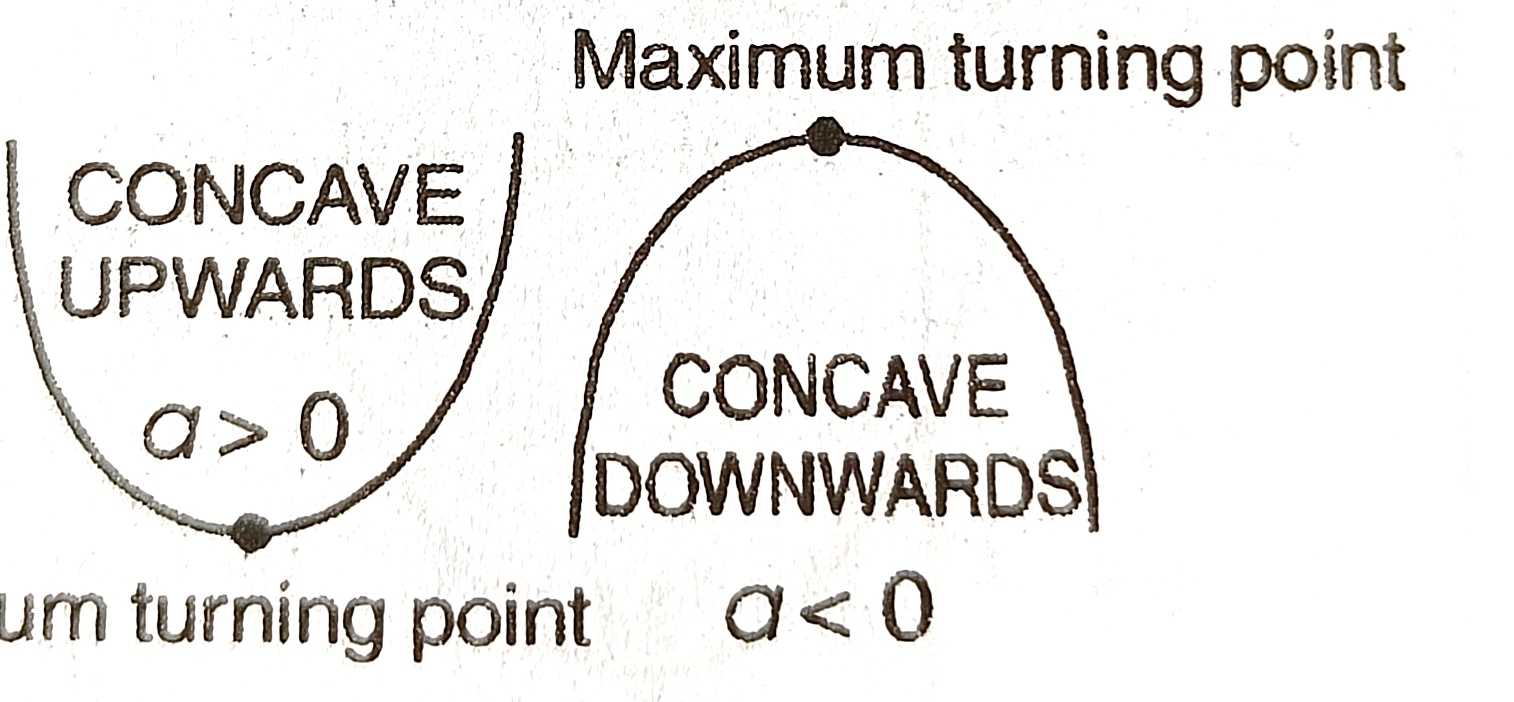
        The graph of a quadratic function is parabola. The point at which its direction changes is called its turning point. It is more commonly called the vertex of the parabola.
        The graph of the function is concave upwards when a> 0 and concave downwards when a< 0.

NOTE:
Studying the nature and character of the roots of a quadratic by graphing:
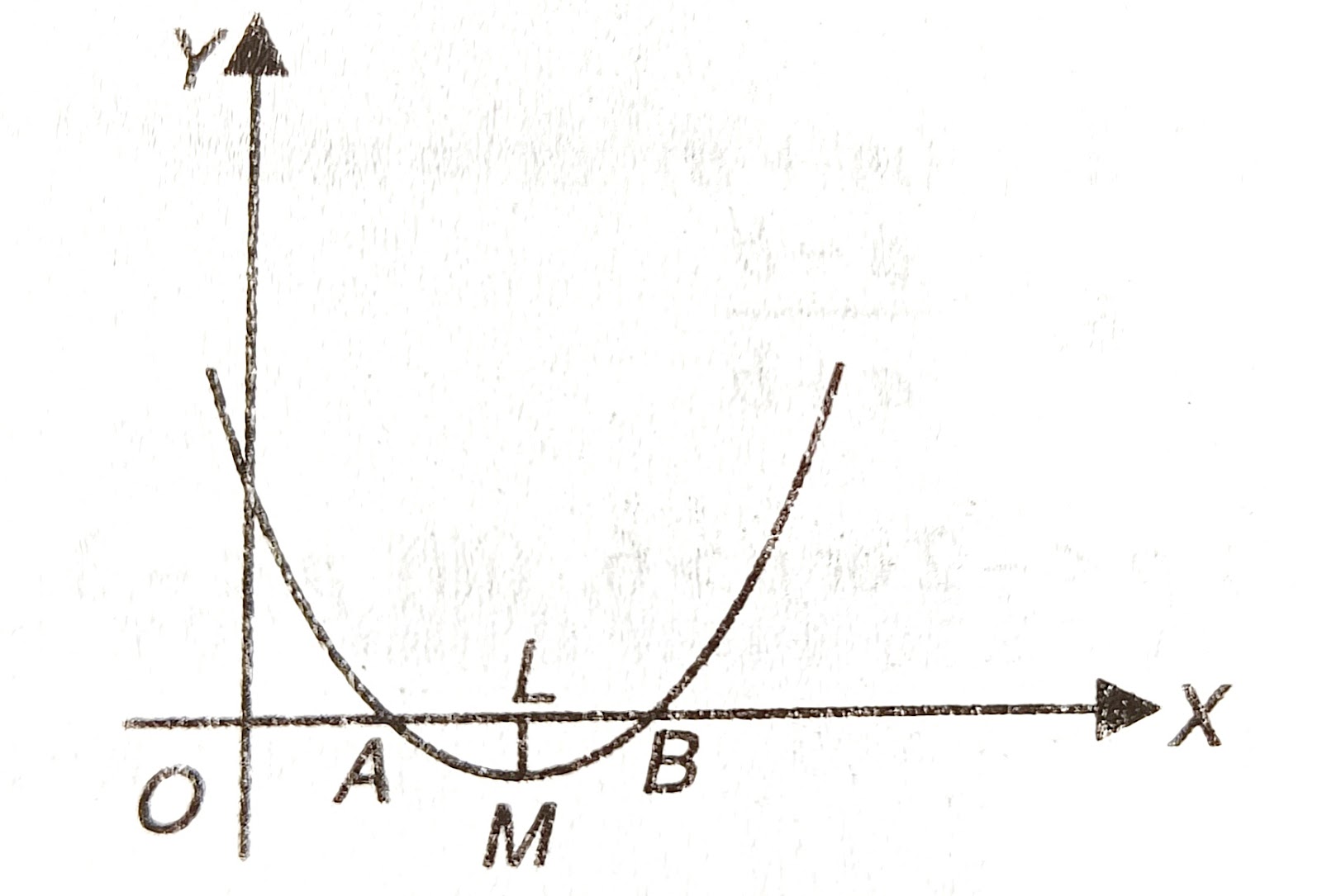
The graph give below illustrate the following cases.
                              Real roots 
Case 1: a > 0       Equal roots
                              Complex roots

                             Real roots 
Case 2:  a< 0      Equal roots
                             Complex roots 

a) If the graph cuts the x-axis, the roots of the equation will be real and unequal. Their values will be given by the abscissa of the points of intersection of the graph and the x-axis.
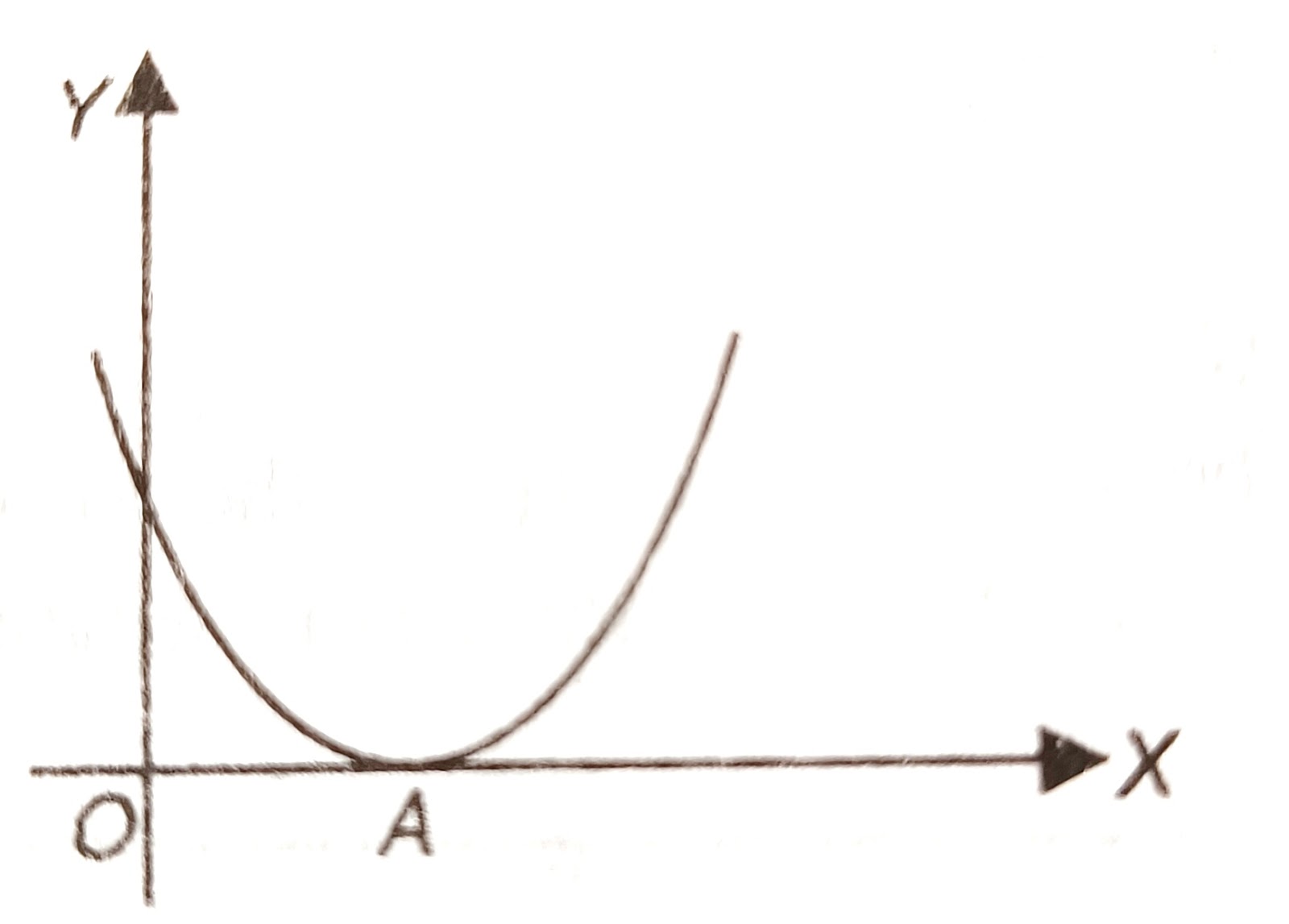
b) If the graph is tangents to the x-axis, the roots are real and equal.
c) If the graph has no points in common with the x-axis, the roots of the equation are imaginary and can not be determined from the graph.

Case 1. When a is positive, i.e., a> 0
Real roots OA and OB 
Minimum value LM= (4ac - b²)/4a at x = OL = -b/2a

ii) b²- 4ac = 0

Real and equal roots 
Each root = OA

iii) b²- 4ac is -ve
Complex roots. Curve entirely above the x-axis with lowest point M at a height 
LM= (4ac - b²)/4a above the x-axis.


Case 2. When a is negative, i.e., a< 0
Real roots OA and OB 
Maximum value LM= (4ac - b²)/4a at x= OL = -b/2a

Real and equal roots 
Each root= OA

Complex roots. The curve lies entirely below the x-axis and the vertex will be at a distance= (4ac - b²)/4a below OX.

Ex: Graph the expression x²+ x - 6.
 
Let y= x²+ x -6
Table values:
x    y
3    6
2    0
1   -4
0   -6
-1  -6
-2  -4
-3   0
-4   6
Note: Real roots of the equation x²+ x - 6= 0 are x= OP and x= OQ, i.e., x= 2 and x= -3 (on reading from the graph)
Minimum value of the function= LM = -6.25 and occurs when x= -0.5.

Ex: Graph the expression 4- 5x - x².

Let y= 4- 5x - x²
Tables of values:
x     y 
-6   -2
-5    4
-4    8
-3   10
-2   10
-1     8
0      4
1     -2
Note: Real roots of the equation 4 - 5x - x²=0 are x= OA and x= OB, i.e., x= -5.71, x= 0.71
Maximum value of the function= LM = 10.25, when x= OM when x= OL= -2.5.

The roots of the quadratic equation ax²+ bx + c= 0, a≠ 0 are the x-intercepts of the graph of y= f(x)= ax²+ bx + c.

Ex: The roots x= 0 and x= 3 of the equation 2x(x -3)=0 are the x-intercepts of the graph of y= 2x(x -3) as shown 
In this case graph cuts the x-axis at two points because there are two real and distinct roots. In the formula the part b²- 4ac > 0

Ex: The two roots x= -5,-5 of the equation (x +5)²= 0 is the x-intercepts of the graph of y= (x +5)² as shown 
In this case the vertex of the graph cuts the x-axis at only one point because the roots are equal. In the formula the part b²- 4ac = 0

Ex: The two roots of the equation x²- 2x +2=0 are 1+ i and 1- i. Therefore the graph of the function f(x)= x²- 2x +2 does not touch the x-axis as shown below because the roots are imaginary.
In this case in the formula the part b²- 4ac < 0

Ex: i) Draw a graph of y= x²- 4x +3 for -2≤ x≤ 5.
ii) Use the graph to solve the equation x²- 4x +3=0.

The table of values is
x: -2   -1  0   1   2   3   4   5
y: 15   8  3   0  -1   0   3   8
To solve the equation it is necessary to find the values of x when y=0, i.e., where the graph crosses the x-axis. These points occur when x= 1 and x= 3, therefore these are the solutions.


Sign of the quadratic function ax²+ bx + c, where x ∈ R.
Since the discriminant D= b²- 4ac of ax²+ bx + c =0 can be positive, zero, or negative, we shall examine what sign of the expression ax²+ bx + c would be in these three cases.
   Let α, β be the roots of the equation ax²+ bx + c=0. Then ax²+ bx + c ≡ a (x - α)(x - β). 
Three cases arise: 
Case I: b²- 4ac is negative (D< 0), i.e., when the roots are complex.
 We have
ax²+ bx + c= a(x²+ (b/a) x + c/a)       Step I. Taking out the coefficient of x².
                   = a[(x + b/2a)² - (b²- 4ac)/4a²].     Step II. completing the square.
As b¹- 4ac is negative, so -(b²- 4ac)/4a² is positive and (x + b/a)² is also positive for real values of x.
Therefore, the expression has the same sign as a.

Case II: b²- 4ac =0 (D= 0), i.e., when the roots are real and equal (α = β)
     ax²+ bx + c= a(x - α)²= a x a positive expression.
Hence, the expression has the same sign as a.

Case III: b²- 4ac is positive (D> 0), i.e., when the roots are real and unequal.
 In this case the roots are real and unequal. Let α > β.
i) We assume that x does not lie between α and β. Then,   
If x> α, (x - α) and (x - β) β both will be positive.     fig 3.08(i)
If x< β, (x -  α) and (x -β) both will be negative.       fig 3.08(ii)
So, the product (x - α)(x - β) will always be positive.
So, ax²+ bx + c ≡ a(x -α)(x - β) ≡ a x a positive expression. 

Hence, the expression has the same sign as a.

ii) If x lies between α and β, then (x - α) and (x - β) will be of opposite signs .
So, The product (x - α)(x - β) will be negative.
So, ax²+ bx + c = a x a is negative expression.
So, ax²+ bx + c and a will be of opposite signs.

From the above discussion it follows that the sign of the expression ax²+ bx + c is always the same as that of a, except when the roots of the equation ax²+ bx + c = 0 are real and distinct and x lies between them.
Values of x  Less than β        between α & β    greater than α
sign of f(x)   same that of a  opposite to that of a  same as that of a 

Tests:
i) A quadratic ax²+ bx + c is positive for all real x of a> 0 and D< 0
ii) A quadratic ax²+ bx + c is negative if a< 0 and D< 0.


 illustrations 
1) The sign of x²+ 6x +12 is positive for real X since D= b²- 4ac = 36 - 47 < 0 and a= 1> 0.
2) The sign of -3x²+ 5x -12 is -ve for all real x since D= b²- 4ac = 25 -4(-3)(-12) = -119< 0 and a= -3< 0

Ex: Find the sign of 6x²- 5x +1 for all real values of x.
D= b²- 4ac = 5²- 4x 6x 1= 1, is positive.
So, the roots are real and different.
By solving the equation, the roots are : 1/2 and 1/3.
So, the given expression has the same sign as the coefficient of x².
i.e., positive for all real values of x except for those which lie between 1/3 and 1/2.

Ex:  Determine the sign of the function 3x²- 2x +1 for real values of x.
 3x²- 2x +1= 3(x²- (2/3)x + 1/3)
                  = 3{(x - 1/3)²+ 1/3 - 1/9}   {completing the square}
                  = 3{(x - 1/3)²+ 2/9}
As x is real, the term (x - 1/3)² is always non negative, and hence the function is positive for all real values of x.

Method II 
D= b²- 4ac = (2)²- 4(3)(1)= -8.
Therefore, the roots of 3x²- 2x +1=0 are imaginary. Hence 3x²- 2x +1 has the same sign as 'a', i.e., 3, i.e., positive (Case I)

Ex: Find the ranges of the values of x for which x²- 4x +2 lies between -1 and +1.
x²- 4x +2> -1 => x²- 4x +3> 0.
Since the coefficient of x² is positive and the roots of x²- 4x +3=0 are 1 and 3, therefore,
x²- 4x +3> 0 for x < 1 or x> 3* .....(1)
Again, x²- 4x +2< 1 => x²- 4x +1< 0
* Since the coefficient of x² is positive and the roots of x²- 4x +1=0 are 2- √3 and 2+ √3, therefore x²- 4x +1< 0, for 2-√3< x < 2 + √3.   ....(3)
   Combining (1) and (2) we get 2- √3 < x < 1 or 3< x < 2 +√3.
which are required ranges of the values of x.

Ex: Determine the values of 'a' so that the expression x⅖- 2(a+ 1)x +4, x ∈ R is always positive.
Given: x²- 2(a +1)x +4> 0 for all x.
Since coefficient of x²= 1 is +ve, therefore, sign of x²- 2(a +1)x +4 is positive if D< 0.
i.e., if 4(a+ 1)²- 16< 0,
=> (a+ 1)²- 2²< 0
=> [(a+ 1) +2] [(a +1)-2]< 0
=> (a+3)(a -1)< 0
=> {a - (-3)}(a -1)< 0
=> -3< a< 1 => a ∈ (-3,1)
 

Note on use a brackets for open and closed intervals.
Sometimet the domains of variation, i.e.,  the intervals are donated as follows:
i) a< x <b is denoted by (a,b) and is called an open interval of the variable x.
ii) a≤ x ≤ b is denoted  by [a,b] and is called a closed interval of the variable x, as x can take up values 'a' and 'b' also.
iii) Any 'x' is denoted by (-∞,  ∞). Here, it should be noted that the symbols -∞, ∞ are not numbers in any sense whatsoever .
iv) x≥ a is denoted by [a, ∞), x ≤ b is denoted by (-∞, b).
v) a≤ x < b is denoted by [a, b], a< x ≤ b is denoted by (a,b). These are called semi closed intervals.

 αβ ∞